




Mythic+ Season 3 rewrites the damage story. Tuning and tier sets have reshaped burst cycles, sustain plans, and how fast you delete a priority target. The leaders sit close enough that execution, route design, and group synergy call as many shots as class. Still, a few specs make runs plainly easier with uncapped cleave, reliable funnel, and party value you feel on every pull.
Here we lay out the list and the why: who moved since last season, what pushed them up or pulled them down, and how boss damage, pack control, target caps, utility, and sturdiness translate into timed keys. Use this tier list to lock a new main, shore up a comp, or justify a spec swap when your margin is measured in seconds. For a faster route through the keys, check our WoW Mythic+ boosting.
DPS role in Season 3 didn’t flatten into parity or blow out into chaos; it polarized at the edges and compressed in the middle. Tuning and tier synergies rewarded plug-and-play damage profiles, reliable burst windows, and clean funnel, while buff-centric or slow-ramp archetypes ceded ground. The frontrunners hold a visible, not runaway, edge; the long A/B corridor is crowded and swings with route design, pull timing, and execution.
Versus late Season 2, the top-and-tail gap is a touch wider, the center denser. Uncapped (or soft-capped) cleave, mobility, and practical party value gained stock; theoretical ceilings matter less than uptime and consistency. Translation: most specs still time keys when piloted well, but comp choices and play discipline bite harder at the margins than they did at Season 2’s finish.
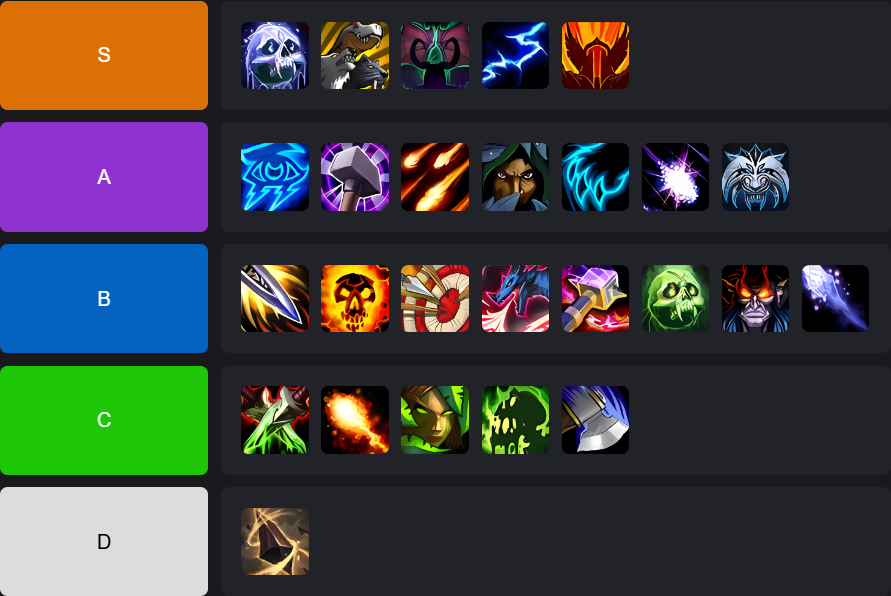
Let’s spell out what the S, A, B, C, and D labels above actually signify for DPS performance in Mythic+:
Frost Death Knight is making a major comeback this season. A recent spec rework removed its clunky reliance on Death and Decay for cleaving and revamped Breath of Sindragosa, resulting in far more consistent damage output. The payoff is immense AoE burst and some of the highest single-target and priority damage in Mythic+. On top of raw damage, Frost DK brings great utility and exceptional durability, which is a huge advantage in high keys. This lethal combination of survivability and top-tier DPS solidifies Frost as an S-tier powerhouse.
Beast Mastery Hunter claws its way to S-tier thanks to significant improvements and an excellent new tier set. The Season 3 tier set greatly boosts BM’s sustained damage, bolstering what was already one of the strongest single-target and AoE outputs among DPS. Unlike many ranged, BM can deal full damage while moving — a perfect fit for the constant movement in Mythic+. It has zero target-capping on its cleave (pet Beast Cleave hits all targets) and benefits from being in physical-heavy comps (since it doesn’t bring a unique raid buff). Aside from lacking a strong party buff (Hunter’s Mark provides trivial benefit in M+ bosses), BM Hunter has virtually no drawback. It even offers Bloodlust via pets and decent crowd-control. All these factors make BM one of the best raw DPS specs this season.
Havoc Demon Hunter remains a top melee pick with very well-rounded capabilities. Although it saw few direct changes, it received one of the most potent tier set bonuses of the season, massively improving its sustained DPS — previously a weak point. Havoc’s AoE and especially its priority-target damage have skyrocketed, allowing it to obliterate dangerous mobs or bosses quickly. Its toolkit also contributes to S-tier status: Chaos Brand (a passive 3% magic damage taken debuff) boosts your caster teammates’ damage, and Darkness provides a clutch group defensive. Combined with great self-sustain and high mobility, Havoc DH easily maintains an S-tier spot as an agile, hard-hitting DPS that any Mythic+ team can appreciate.
Bolstered by substantial buffs this season, Elemental Shaman has risen to meta status. Its single-target damage — historically a weakness — was massively improved leading into Season 3, so Ele can now melt bosses in addition to dominating AoE. This spec delivers incredible burst and chain-lightning cleave on packs, plus amazing priority-target damage to focus down high-health enemies. Just as important, Elemental brings coveted party utility: Bloodlust for speedier clears, Capacitor Totem for AoE stun, Purge for removing enemy buffs, and off-healing or saves. Its sustained DPS can be a bit inconsistent if you’re unlucky with Ascendance procs or tier-set triggers, but that is a small trade-off. Overall, few specs can match an Elemental Shaman’s mix of damage and utility in Mythic+ right now.
Fury Warrior charges into S-tier due to relentless tuning buffs. Over the past few weeks, Fury received multiple damage increases that put it in much better shape than before. Its AoE output, while technically limited by a 5-target cap on core abilities, is now ferocious enough to annihilate typical pulls, and its single-target burst and execute phases have greatly improved as well. Fury also synergizes extremely well in physical damage comps: it provides Battle Shout, a 5% Attack Power buff that boosts all melee allies’ DPS. Combine this with Fury’s own survivability (self-healing from Bloodthirst) and the fact it loses little uptime while moving, and you have a melee spec that brings both team buffs and consistent, high-octane damage every run. (Its one minor drawback is being melee in a heavy-movement dungeon, but mobility via Heroic Leap helps). In short, Fury’s raw power plus group utility earn it a well-deserved S-tier spot.
Arcane Mage brings explosive AoE and some of the best single-target burst in the game, making it a great pick for both trash and boss fights. This spec’s rotation was adjusted for Season 3, but it retained its hallmark burst-oriented profile — meaning with cooldowns like Arcane Surge it can erase packs, and then funnel that burst into priority targets when needed. In fact, Arcane’s ability to convert AoE into focused damage is among the strongest, which can save significant time on high-health targets. It also offers valuable group utility: an Intellect buff for casters and crowd control tools. Arcane Mages are surprisingly durable too, reducing the risk of deaths. The main limitation keeping Arcane out of S-tier is its reliance on careful setup and mana management — in less coordinated groups or very high-mobility fights, it can drop off. Even so, in skilled hands Arcane Mage is an A-tier DPS that borders on S-tier performance.
After an extensive rework in the previous patch, Retribution Paladin remains a formidable melee DPS in Mythic+. Ret boasts strong burst AoE thanks to talents like Divine Storm and Empyrean Legacy, and recent buffs have shored up its once-weak single-target damage (though it’s still not top of the pack). It did suffer a nerf to one AoE talent, slightly reducing its sustained output, but compensation tuning has kept Ret’s overall AoE very competitive. What really makes Ret shine is its outstanding utility and off-healing. No other DPS brings abilities like Lay on Hands, Blessing of Protection, and an aura that can reduce damage taken by the group. These tools can single-handedly save runs when things go south. Ret Paladins also have strong personal defenses (Divine Shield, Shield of Vengeance), making them quite self-sufficient. While a bit less mobile than some melees, a well-played Ret offers a balance of damage, survivability, and team support that firmly places it in A-tier.
Destruction Warlock has secured a solid spot in A-tier due to its phenomenal AoE and well-rounded kit. In large pulls, few specs can match Destruction’s output — Rain of Fire allow it to dish out some of the best mass AoE damage, especially in higher keys where enemies live longer. At the same time, Destruction delivers respectable single-target DPS, and its sustained damage between burst phases is strong, so it doesn’t fall off on longer fights. One notable weakness is handling priority targets during AoE — Destro lacks on-demand funnel damage (if one mob needs to die faster, Destro can’t easily focus it without losing overall DPS). However, this is mitigated if the group has other specs to handle priority burns. They’re also among the tankiest DPS, which is invaluable in high Mythic+. All told, Destruction is a well-rounded spec and a safe A-tier pick that excels whenever big AoE damage is needed.
Subtlety Rogue combines the Rogue class’s signature crowd control and utility package with sky-high damage potential. Subtlety is especially known for its burst: its single-target nukes (powered by Shadow Dance and finishers like Secret Technique) are among the strongest, allowing Sub to delete priority targets or bosses in short order. At the same time, a well-played Sub Rogue can unleash incredible AoE — it’s considered one of the strongest AoE melee specs, courtesy of tools like Black Powder and Shuriken Storm cleave. If there’s any drawback, it’s that outside of burst windows, Subtlety’s sustained AoE dips a bit. But given how much else the spec offers, that’s a small price to pay. With Sub’s improved damage across the board this season, you get the best of both worlds: elite Rogue utility and A-tier DPS output.
Feral Druid quietly holds its own as a strong melee choice this season. It received some positive changes, maintaining its identity as a burst-oriented spec with huge damage during Berserk windows while still suffering a bit during downtime due to energy starvation. In Mythic+, Feral’s strength lies in spread AoE and multitarget sustained damage — its bleeds can blanket entire pulls and tick hard, allowing Feral to excel on packs of mobs. Meanwhile, abilities like Ferocious Bite ensure that Feral’s single-target or priority damage is also quite competitive when focusing down tougher enemies. Like Balance, Feral brings the valuable Mark of the Wild buff and off-healing utility, along with Battle Rez and powerful crowd control. These tools bolster any group’s defensive profile. Feral does require careful resource management — during low energy periods, its DPS can feel “stalled” which separates top Ferals from the rest. Overall, while Feral Druid isn’t as visibly dominant as some S-tier specs, it provides a reliable mix of AoE, single-target, and utility that lands it solidly in A-tier.
Balance Druid remains a great all-around DPS spec for Mythic+. Balance still boasts one of the best uncapped AoE toolkits — spamming Starfall and multi-DoTing with Sunfire/Moonfire allows it to melt large packs of enemies with ease. Coming into Season 3, Balance did receive some nerfs: the loss of its previous tier set removed a unique “funnel” playstyle that had contributed to its S-tier performance last season. This nerf, along with minor talent tweaks, knocked Balance down a peg in overall damage. Even so, its AoE output is still excellent (recent aura buffs helped keep its damage competitive) and single-target is improved compared to before — just not quite top-tier.
Windwalker Monk’s Mythic+ value is higher than its raw damage numbers alone suggest. In pure output, Windwalker is strong — it delivers rapid-fire AoE burst with Spinning Crane Kick and Fists of Fury, though it remains one of the few specs with a target cap (hitting only ~5–6 targets per ability) which can be a drawback on gigantic pulls. Its single-target burst is also potent (few things beat a WW Monk burning a big cooldown combo into a priority mob). However, Windwalker did get hit with some nerfs to both its ST and AoE recently, so it’s not topping the charts outright. What keeps Windwalker in A-tier is its utility and the synergy it offers in physical damage comps. Monks provide Mystic Touch, a unique debuff increasing all physical damage the enemies take — a huge boost if your team includes specs like Warriors or Rogues. They also bring Leg Sweep, Ring of Peace for kiting/control, and Diffuse Magic/Fortifying Brew for survivability. In a group with other physical DPS, a Windwalker can significantly elevate the team’s overall damage output. Even if its own DPS isn’t S-tier, the Monk’s contribution to the party and its well-rounded kit justify an A-tier ranking.
Once the king of Mythic+ melee DPS, Outlaw Rogue has settled into B-tier in Season 3. It still offers excellent sustained damage on packs — Outlaw’s cooldowns are short, allowing for consistent AoE on every pull. However, the spec remains target-capped (its cleave via Blade Flurry only hits a limited number of targets), so its AoE potential on very large pulls is throttled compared to uncapped specs. Recent updates did improve Outlaw: it got some general damage buffs and a rework to Killing Spree, which greatly improved its quality of life and burst options. Single-target was also buffed, addressing Outlaw’s previous weakness on bosses. Add in the Rogue toolkit (stellar crowd control, Tricks of the Trade, immunity with Cloak, etc.) and Outlaw remains a reliable pick. It’s just that other melee (like Subtlety or Havoc) now outperform Outlaw on damage without the target cap limitation, keeping Outlaw out of the top tiers.
The revamped Shadow Priest is a bit of a dark horse in Mythic+ — strong in the right scenario but still held back by ramp-up needs. The rework leading into Season 3 gave Shadow a much more streamlined kit and significantly improved damage output. It excels at priority-target and single-target damage; with Devouring Plague and buffed Mind Blast, a Shadow Priest can chunk bosses or elites down efficiently. Its AoE is decent as well, especially on sustained fights where Psychic Link spreads its single-target damage to multiple enemies once DoTs are up. The issue is that getting all your DoTs applied and ramping up insanity for cooldowns takes time — in fast-paced dungeon pulls, Shadow can lag behind burstier specs. In higher keys where pulls live longer, Shadow’s damage becomes more valuable (and indeed, at the cutting edge it performs well). It brings tremendous utility: Power Infusion, Mass Dispel, Vampiric Embrace for emergency healing, and Power Word: Fortitude stamina buff. Overall, Shadow Priest is much improved this season and is perfectly viable, but its reliance on ramp-up and coordination keeps it in B-tier for general meta rankings.
Marksmanship Hunter remains an explosive ranged DPS choice that is just a notch below the top tiers. MM Hunter’s claim to fame is massive burst damage on demand which can delete entire packs in seconds. This burst-centric playstyle is incredibly useful in lower to mid-level keys where things die quickly, and indeed MM is often considered one of the best specs for “bursting down” low HP mobs. Going into Season 3, MM received numerous changes and actually saw its single-target output improve compared to last season. However, after some recent nerfs, its overall ranking has slipped a bit. MM lacks the sustained damage that BM offers — once its initial burst is done, its damage can taper off, and it has to wait for cooldowns. It also doesn’t have a pet out by default (unless talented otherwise), meaning it can’t off-tank or use pet utility as readily as BM or Survival. Despite these drawbacks, MM is still an “above average” performer with the right setup, and it’s certainly capable of doing big damage in Mythic+. It’s just slightly overshadowed by the more well-rounded specs above it.
Devastation Evoker has seen a notable rise in Season 3 thanks to various buffs and talent improvements. Once known mostly for burst, Devastation now has much better sustained damage to complement its big cooldowns. It still excels at burst AoE — tools like Deep Breath can obliterate clustered mobs — but now after the initial spike, Devoker continues contributing meaningful damage instead of falling off dramatically. It retains the unique Evoker utility kit: fast group movement, an emergency rescue pull, and even the ability to provide Bloodlust. One limitation is Devastation’s 25-yard range, which sometimes forces it closer to danger compared to other casters. It’s also not the sturdiest spec, so positioning and smart defensive usage are key. Overall, while Devastation Evoker isn’t as universally dominant as the top few specs, its improved damage output and useful utility have cemented it as a solid B-tier DPS that can shine when played well.
Enhancement Shaman brings a jack-of-all-trades style to Mythic+. The spec got a modest bump from its new 4-piece tier set, which helps reinforce its excellent AoE damage. In practice, Enhancement can unleash a flurry of melee strikes — spreading flames through packs and chaining cleave finishers — often topping meters in medium-sized pulls. It also has outstanding funnel capability, focusing a priority target while maintaining AoE pressure, whether you lean into elemental-spirit setups or more strike-heavy builds. Despite these strengths, Enhancement isn’t breaking into A-tier mainly because its single-target is still under-tuned (especially next to Elemental). On boss fights, Enh can feel merely average. That said, it provides one of the best utility toolkits in the game: Windfury Totem for extra swings to physical teammates, a reliable AoE stun to control packs, offensive and defensive dispels, solid self-healing, and Bloodlust when needed. This utility, combined with very solid AoE, makes Enhancement a well-rounded spec. It might not top DPS charts overall, but it contributes plenty to warrant a spot in B-tier — and in the right comp, it can punch above that rank.
Unholy Death Knight underwent significant changes this season, but it finds itself slightly behind its Frost counterpart in Mythic+ performance. The kit picked up new options while losing last season’s overtuned tier bonus, which reined in some of its peak damage. The replacement set is solid rather than transformative, and Unholy no longer has Abomination Limb in keys the way it did last season — so the pack-grip utility that made pulls cleaner is gone, shaving off a bit of team value. Even so, the spec is still an absolute menace on large pulls — spreading diseases, triggering burst windows, and letting an undead entourage melt stacked packs — but it isn’t leaps and bounds above other AoE specialists like it was before. Single-target is decent but not exceptional, and unlike Frost, Unholy still doesn’t offer a standout party buff. On the plus side, it remains very durable and brings hallmark Death Knight tools for control, anti-magic protection, and a combat resurrection, all of which are always valuable. After some minor Frost trims, Unholy has crept closer in output, just not enough to overtake it. All told, Unholy DK is a strong B-tier DPS: very capable in skilled hands and devastating on the right pulls, but a notch below the top meta picks due to losing last season’s extra edge.
Demonology Warlock received one of the strongest tier-set upgrades in Season 3, instantly boosting sustained output and especially its single-target punch. With the new set and some baseline nudges, Demo can maintain a steady battalion of pets and deal heavy damage even outside major cooldowns, while its primary burn window with Demonic Tyrant now hits harder than before — making it a frontrunner among Warlock specs for pure boss damage. In Mythic+ AoE it’s solid, delivering frequent mini-bursts and efficient cleave via Dreadstalkers and imps, though it won’t always blow up giant packs as explosively as Destruction. After a few number trims its standing slipped slightly from the early-season peak, but it remains a good choice in keys. Warlock fundamentals help here — sturdy defenses, healthstones and gateways, and pet-driven control like Felguard’s Axe Toss. The tradeoff is complexity and ramp-up: building shards, summoning, and empowering the demon swarm takes setup and can be a minor hindrance on short-lived pulls, though a practiced player smooths that out. In summary, Demonology offers excellent sustained damage and exceptional boss performance, placing it confidently in the B-tier — a reliable pick, especially when your group needs strong single-target pressure.
While not at the very top, Frost Mage sits comfortably in B-tier as a dependable ranged DPS. Season 3 brought some tweaks: a buff to Frost’s Mastery and a longer cooldown on Blizzard (forcing more focus on core nukes like Glacial Spike and Ice Lance), along with a new 4-piece tier set that enhances its burst damage rotation. In Mythic+, Frost Mage’s burst AoE is quite potent – Frozen Orb and Comet Storm can do significant area damage, especially when combined with Winter’s Chill debuffs to make targets take increased crits. Its single-target is now surprisingly strong as well, which helps burn down bosses or priority targets. The spec’s greatest contribution, however, might be its control and safety. Frost brings unrivaled slows and roots, making kiting easier for your tank. This level of control can trivialize dangerous melee enemies. Additionally, like all Mages, Frost has excellent survivability and group utility, which adds value beyond raw DPS. The reason Frost isn’t higher is that its overall damage, while good, can be outpaced by flashier specs, and it heavily relies on frequent casting – movement-heavy encounters can lower its output. Still, in experienced hands, Frost Mage offers a very balanced package of damage, control, and toughness.
Despite receiving massive buffs to both its base kit and tier set going into Season 3, Assassination Rogue still struggles to find a spot in Mythic+ groups. On paper, its AoE damage actually became quite formidable – spreading Garrote and Poison bleeds with Fan of Knives and popping Crimson Tempest can yield great sustained AoE, and Assassination excels at doing heavy “priority” damage while cleaving (its poison bomb procs and empowered bleeds hit the primary target hard). However, the spec’s Achilles heel is single-target burst. Even after recent buffs, Assassination’s direct single-target damage is mediocre compared to other DPS. In Mythic+, this is most apparent on boss fights – an Assassination Rogue might do fine on trash and then see their damage plummet against a lone boss. The only way to offset this is to pull extra mobs into the boss fight so the Sin rogue can “funnel” via AoE, which isn’t always practical. Rogue utility is still top-notch, and Assassination can certainly demolish certain pulls with its empowered bleeds, but given its limitations and the fact that Subtlety or Outlaw can cover most of Rogue’s niche with fewer drawbacks, Assassination is currently sitting in C-tier.
Fire Mage took a huge hit in Season 3. It was hammered by consecutive nerfs right before the season, leaving its AoE and single-target damage much lower than before. Minor buffs since then have helped a little, but Fire still struggles to compete with Arcane or Frost in most Mythic+ situations. Fire’s strength traditionally scales with large pulls and long fights – in very high-level keys where packs live longer, its Ignite spread and Flame Patch can ramp up and shine. However, in typical runs, enemies often die before Fire’s damage fully kicks in, so it rarely gets to excel. It does retain the usual Mage perks, and a skilled player can still make it work. Yet until Fire receives more substantial tuning, it remains a C-tier pick that is generally outclassed by other ranged DPS.
Survival Hunter is much improved this season but remains a niche pick. Its sustained damage is the best it’s been all expansion – short cooldowns let Survival chain powerful bursts every pack. In particular, it shines in AoE: Survival can carpet-bomb pulls with Wildfire Bombs and cleave with Butchery, dealing impressive area damage alongside solid priority-target hits. Its single-target is also respectable now. So why C-tier? Mainly competition and utility. As a melee with no unique party buff, Survival struggles to justify a spot over BM or MM. It’s certainly stronger than it was in Season 2 and can perform well, but it remains an uncommon choice – hence C-tier.
Affliction Warlock got significant buffs in Season 3 (making it stronger than it’s been all expansion), but it still struggles in Mythic+ compared to other DPS specs. On the plus side, Affliction’s single-target, funnel, and sustained AoE damage all improved noticeably — if allowed to ramp up on a large pack, it can deal huge damage through its DoTs and Malefic Raptures. The downside is Mythic+ favors burst, and Affliction is inherently a ramp-up spec. It still relies on Vile Taint to quickly spread Agony, which is clunky on short-lived packs. If mobs die too fast, Affliction’s damage never gets going, and when its cooldowns are down its output also drops off. In practice, even after the buffs, most groups prefer Demonology or Destruction for more immediate damage. Unless you’re in a scenario where multi-dotting can fully shine, Affliction remains underwhelming in dungeons — hence its C-tier placement.
Arms Warrior has gotten a lot of help from Blizzard this season — multiple buffs have significantly raised its damage potential. Now Arms can deliver solid AoE bursts and strong single-target/execute damage, especially under its cooldowns. It also benefits the party with Battle Shout just like Fury does, and can fit well into physical-heavy groups. However, Fury is still generally favored for Mythic+ due to its uncapped AoE and better self-sustain. Arms is more bursty and less sustained, and it’s a bit squishier without Fury’s constant healing. Thus, despite Arms being much stronger than before, it remains an uncommon sight. You can absolutely time keys as Arms, but given that Fury offers similar or greater value with fewer drawbacks, Arms stays in C-tier for now.
Augmentation was a meta-defining spec last season due to its powerful buffing toolkit, but in Season 3 its value has dropped sharply. The spec itself hasn’t changed much – it still provides strong offensive and defensive buffs – but now a pure damage dealer often yields faster dungeon clears. Aug’s personal DPS is very low, so unless its buffs enable a specific high-level strategy, bringing an Aug tends to slow down Mythic+ runs. While Augmentation remains fantastic for boosting allies’ damage and survivability, in speed-focused Mythic+ it’s considered sub-optimal. In short, a regular third DPS contributes more raw damage in most cases, so Augmentation currently sits at D-tier (until tuning or meta shifts bring it back).
The Mythic+ DPS meta in Season 3 has proven to be quite dynamic. We’ve seen formerly top-tier specs (like Augmentation Evoker or Fire Mage) fall off, while others have surged forward thanks to class reworks, tuning passes, or new gear synergies.
Keep in mind that player skill and group composition can let any spec beat the odds – but if you’re looking to optimize, the tiers above provide a general guideline for which DPS specs offer the easiest path to success in Season 3 Mythic+. As always, balance changes can still later in the season, so these rankings may evolve. For now, these are the best DPS specs dominating Mythic+ and the reasons they’re on top (or not). Good luck and happy key pushing!