




Profession Stats and Concentration are the two systems that decide whether your crafts hit max quality, whether your gathering runs are efficient, and whether the gold you sink into profession gear actually pays itself back.
Midnight keeps the broad framework familiar from The War Within, but the numbers, item names, and several mechanics have shifted enough that old habits will misfire if carried over directly. This guide breaks down how every crafting and gathering stat behaves in Midnight, how Concentration interacts with skill and quality, what gear and consumables move those numbers, and where the stat priorities land for different play styles.
Every crafting recipe in Midnight has two numbers that decide its outcome: Recipe Difficulty and your effective Skill. Recipe Difficulty is fixed per recipe and represents the Skill required to hit the highest possible quality. Skill is your character's combined value — base profession skill, specialization bonuses, the quality of reagents loaded into the craft, and any special items applied. The closer Skill sits to Recipe Difficulty, the higher the Expected Quality of the result, and the less Concentration you need to push the craft to the next quality tier.
Quality tiers themselves have been streamlined in Midnight. Crafted equipment still uses the familiar five-tier scale, but consumables now drop from three quality levels to two. That single change matters more than it sounds — Quality 1 is now the default starting point for consumables, and one Concentration push immediately reaches the maximum Quality 2 result. The grind from "low quality" to "top quality" on flasks, potions, and food is structurally shorter than it was in The War Within.
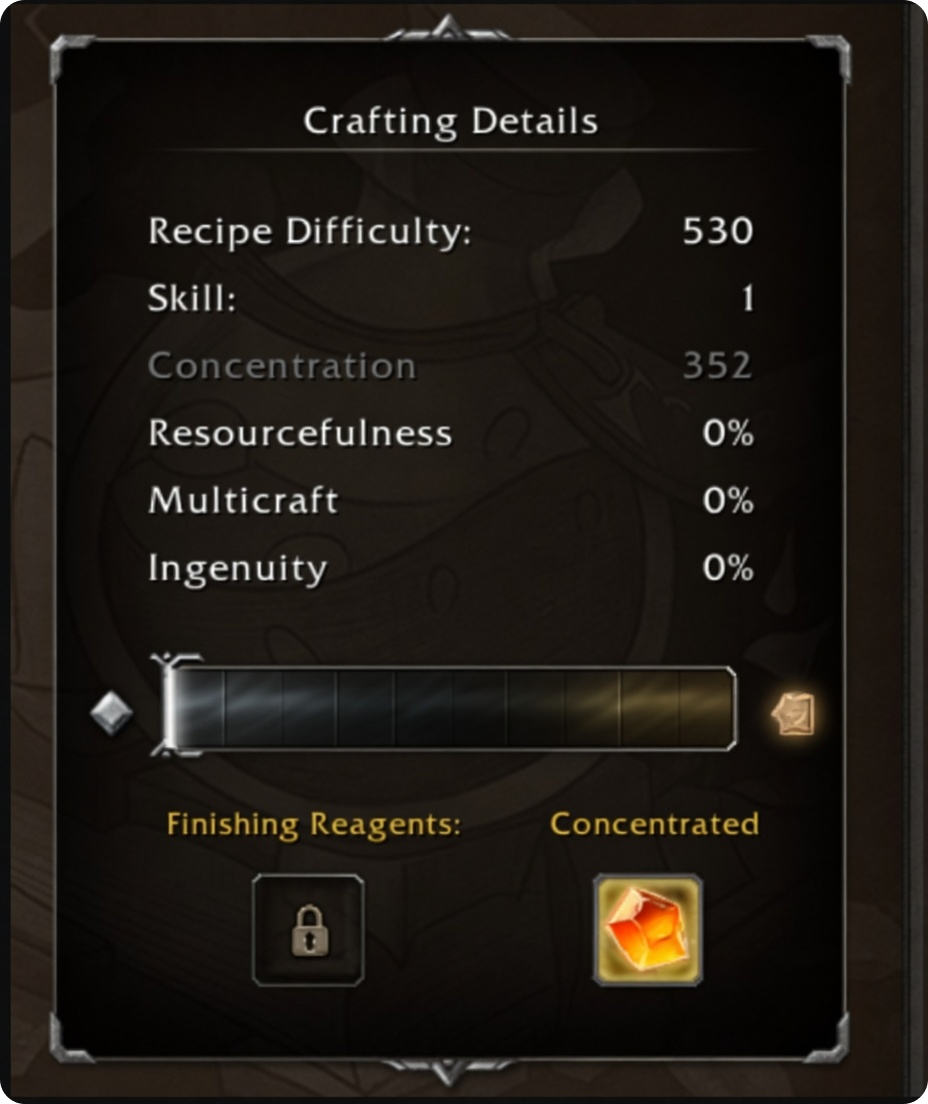
The Expected Quality bar in the crafting window shows where the recipe will land at current Skill, before any Concentration is spent. If the bar already sits at the maximum tier, no Concentration is needed at all — Skill alone carries the craft. If it sits one tier below the maximum, Concentration can guarantee the next quality level for a cost that scales with how many Skill points short the craft is. The shortfall and the cost are non-linear: closing the last gap to maximum quality is dramatically more expensive per Skill point than closing the first.
Skill in a craft is fed by the following sources, all stacking together:

Concentration is the headline mechanic of the entire Midnight profession system — a finite, slow-recharging resource that lets a crafter guarantee the next quality tier on any single craft, regardless of whether Skill alone would have reached it. Every crafting profession carries its own independent pool tied to the specific character and the specific profession; a character with both Enchanting and Tailoring runs two separate bars in parallel.
The cap is 1000 per profession per character, and recharge is 1 point every 6 minutes — so 10 per hour, 240 per day, and roughly 100 hours from zero to full. That long window is why Concentration crafting is treated as a slow-tick passive income stream rather than a burst activity. Cooking is the one crafting profession excluded entirely, since cooked food does not use the quality system that Concentration interacts with.
The cost of pushing a craft to the next tier is not flat. It depends on how many Skill points short the craft is and on your Ingenuity, which both lowers the base cost and refunds part of what you spend. The structure is a fixed base plus a variable cost per Skill point of shortfall, and the curve is non-linear: closing the last few points before the maximum tier is dramatically more expensive than closing the first. Practically, Concentration pays off most when you are already within striking distance of the next tier — spending 800 Concentration to bridge a huge Skill gap on a craft you are not properly geared for is almost always a worse use of the resource than waiting for Skill to catch up.
Because the recharge is per-character per-profession, many serious crafters maintain Concentration alts — secondary characters with the same crafting profession, used purely as additional 1000-point pools. With three or four alts geared for Concentration crafting, weekly throughput multiplies without any change to the core mechanic. It is a flat-out optimization that costs nothing beyond the time to set the alts up and a bit of profession gear on each one.
The Ingenuity stat gives a percentage chance to trigger an Ingenious Breakthrough — a refund of part of the Concentration spent on that craft. The base refund is around half of what was spent, and specialization talents (most notably Immaculate Ingenuity at +1% per point) push it higher. The hard ceiling in Midnight is 70% refund even with everything fully invested — a deliberate nerf compared to The War Within, where the cap was higher. The remaining 30% floor is what keeps Concentration meaningful: there is no setup that turns it into a free resource.
Spend Concentration where the quality bump materially changes the item's value:
Do not spend it on items you plan to vendor for skill leveling, items you plan to Disenchant for materials, or crafts where the lower quality already sells profitably and the higher tier does not justify the Concentration cost.
There are four crafting stats in Midnight that appear on profession gear and are influenced by specializations: Multicraft, Ingenuity, Resourcefulness, and Crafting Speed. Each stat shines in a specific situation, and the wrong stat on the wrong craft contributes nothing — choosing what to gear for is one of the highest-leverage decisions a crafter makes.
Multicraft grants a baseline chance to produce extra items from a single craft. The proc multiplier ranges from 1× to 2.5× the usual yield, averaging around 1.5× when it fires. A craft that normally yields 5 potions might produce 8 with a Multicraft proc; a craft that yields 2 of something might grant 1 to 5 extra. Specializations increase both the proc chance and the bonus quantity per proc.
Multicraft only applies to items that can stack. Crafted gear, profession tools, and one-off items do not benefit from it at all. The single exception is Enchanting — enchant crafts can multicraft despite producing scrolls, which is unusual relative to the general rule.
Where Multicraft works, it is the strongest stat in the game by a wide margin for goldmaking purposes. A 20% proc chance returning an average of 1.5× yield translates directly into roughly 30% more output for the same materials, which dwarfs the cost-savings from Resourcefulness or the Concentration efficiency from Ingenuity.
Multicraft is the priority stat for:
Ingenuity replaced the old Inspiration stat from The War Within, and its function is completely different. Where Inspiration gave a chance for bonus Skill on a craft, Ingenuity gives a percentage chance to trigger an Ingenious Breakthrough — a refund of part of the Concentration spent on that craft. Through specializations, Ingenuity also lowers the base Concentration cost of crafts, meaning the stat saves resources on both the front end and the back end.
The refund percentage scales from a base of around 50% up to a hard cap of 70% with maxed knowledge talents. That ceiling is lower than The War Within's equivalent and is one of the more impactful balance changes Midnight made to the crafting economy.
Ingenuity is the single most valuable stat for crafts where you intend to spend Concentration — that is, max-quality crafted gear, max-tier consumables sold at scale, and any work order where the customer is paying a premium for guaranteed top quality. For Enchanting specifically, Ingenuity is often the strongest stat overall, since enchants benefit from Multicraft only in limited contexts and Concentration spending dominates the high-value enchant market.
Ingenuity is the priority stat for:
Resourcefulness grants a chance to consume fewer tradeable reagents on a craft. The savings can be dramatic on the high end — a single proc on an expensive craft can save 100+ units of a primary reagent — but the average saving across many crafts is small, and the saved materials are often the cheaper components rather than the truly expensive ones.
For most use cases, Resourcefulness is the weakest of the four crafting stats. The exception, and it is a meaningful one, is work orders. When you are crafting an item paid for by another player using their materials, Resourcefulness saves your reagents while the customer still pays the full crafting fee — that makes Resourcefulness the only stat that directly improves work order profitability, which is why dedicated Crafting Order specialists prioritize it heavily.
Resourcefulness is the priority stat for:
Crafting Speed reduces the cast time of crafts. It is genuinely useful for mass production — anyone listing hundreds of items per day on the auction house notices the time savings — but it has essentially no effect on the value of any individual craft. The output is identical with or without it.
For this reason, Crafting Speed is never a stat you specifically gear for. You will pick up substantial amounts of it from specialization talents and secondary rolls on profession gear regardless. The only situation where stacking it intentionally makes sense is when none of the other three stats apply to what you are crafting and you just want to finish the queue faster.
The applicability of crafting stats is governed by three rules of thumb:
There are three gathering stats in Midnight: Finesse, Perception, and Deftness. They are not strictly ranked — the right balance depends entirely on what you actually want out of each gathering session. Finesse and Perception in particular pull in opposite directions, and the optimal split changes depending on whether you are farming raw quantity or chasing rare drops.
Finesse increases the amount of base material gathered from each node. A node that would normally yield 1 to 2 ore can return 4 to 5 with high Finesse. The bonus applies across all three gathering professions — Mining, Herbalism, and Skinning — and it scales linearly with the stat.
Finesse is the primary stat for raw goldmaking through gathering. If your goal is to convert farming time into auction house listings of common reagents, every point of Finesse translates directly into more sellable material per hour.
Perception increases the chance to find rare side gathers when working a node. That includes rare reagents used in high-end recipes and, importantly, Knowledge-enhancing items that grant profession Knowledge Points when looted. The latter makes Perception relevant even for gatherers who already have all the gold they need — it is one of the more reliable ways to accelerate Knowledge Point accumulation alongside the standard weekly sources.
Perception is functionally the opposite of Finesse. Where Finesse maximizes the quantity of common materials, Perception maximizes the chance of rare or unique procs from a node. Most serious gatherers tune for one or the other depending on session goals rather than splitting between them.
Deftness increases gathering speed — the cast time of mining, herbing, and skinning a node. Higher Deftness means faster nodes, which translates directly into more nodes worked per hour during long farming sessions.
Deftness is also critical on Midnight's hazardous gathering nodes, where the ability to finish gathering before the trap mechanic activates can be the difference between a successful gather and a wipe. See the dedicated Hazardous Gathering Nodes section below for details. For routine farming on safe nodes, Deftness is a quality-of-life upgrade; for hazardous farming, it borders on mandatory.
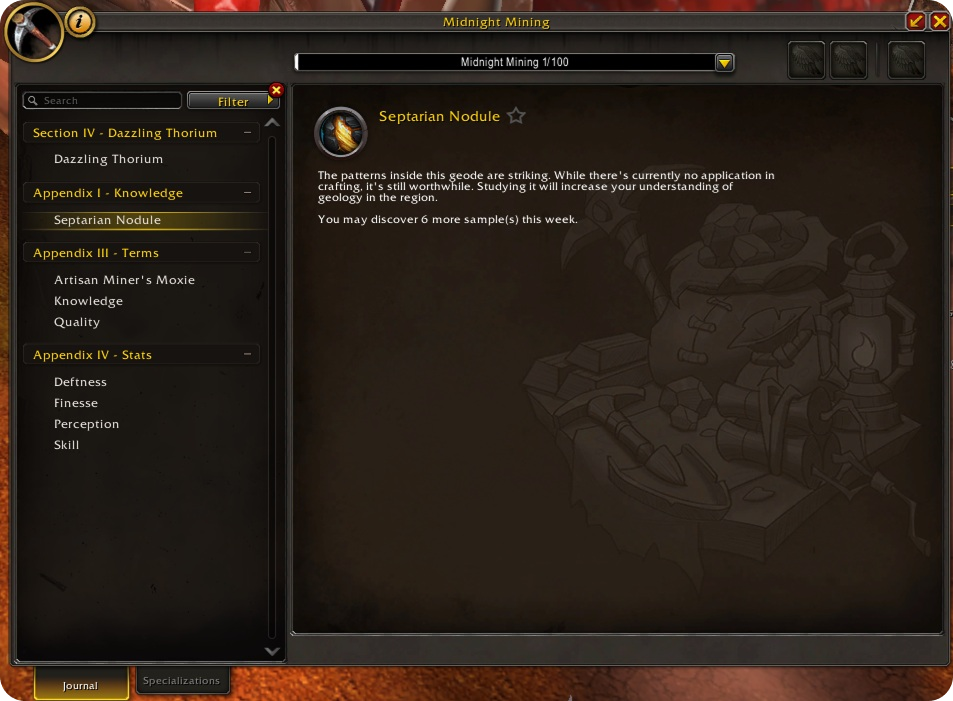
The "best" stat depends entirely on what you are trying to accomplish. The following priorities are practical defaults that hold across most professions and recipes.
| Goal | Stat Priority |
|---|---|
| Mass-producing stackable consumables (potions, flasks, scrolls) | Multicraft > Ingenuity > Resourcefulness > Crafting Speed |
| Crafting max-quality gear with Concentration spend | Ingenuity > Resourcefulness > Crafting Speed (Multicraft does not apply) |
| Enchanting (any tier) | Ingenuity > Multicraft > Resourcefulness > Crafting Speed |
| Customer Crafting Orders as a primary income source | Resourcefulness > Ingenuity > Multicraft > Crafting Speed |
| Long farming sessions of common materials | Finesse > Deftness > Perception |
| Hunting rare drops and Knowledge-bearing items | Perception > Deftness > Finesse |
| Hazardous node farming (Wild, Voidbound, Lightfused, Void Deposits) | Deftness > Perception > Finesse |
| Concentration alts (secondary characters used purely for additional Concentration pools) | Ingenuity > Resourcefulness > everything else |
A few cross-cutting principles tie all of this together:
Profession gear in Midnight is split into three quality tiers — cheap green Bind on Equip pieces, blue Bind on Pickup gear, and epic Bind on Pickup gear that can roll significantly higher stats at top quality. The full set bonus is a flat profession Skill increase that stacks across all worn pieces:
The +40 Skill from a full blue set is the practical target for any serious crafter. Once you have it plus full specialization and full base skill, Concentration spending becomes optional on most crafts rather than mandatory. Several races also provide a passive +5 Skill bonus to specific professions, which lets a single blue accessory plus base skill plus specializations hit the same max-rank result that other races need a full blue set for — race choice is not required for top-tier crafting, but it does materially lower the gold cost of reaching the same effective Skill level.
Profession tools can be enchanted with stat bonuses. Midnight covers six of the seven profession stats with dedicated tool enchants — Crafting Speed is the only stat without one, since it is generally picked up automatically from talents and gear without needing a slot. The enchant variants are themed around four Midnight factions (Sin'dorei, Ren'dorei, Amani, and Haranir):
| Stat | Enchant |
|---|---|
| Deftness | Enchant Tool - Sin'dorei Deftness |
| Perception | Enchant Tool - Amani Perception |
| Finesse | Enchant Tool - Haranir Finesse |
| Ingenuity | Enchant Tool - Ren'dorei Ingenuity |
| Resourcefulness | Enchant Tool - Amani Resourcefulness |
| Multicraft | Enchant Tool - Haranir Multicrafting |
Thalassian Missives are Inscription-crafted optional reagents added during the crafting of a profession tool. They lock a specific stat onto the tool — instead of leaving the stat roll up to chance, you guarantee the tool produces the stat you want. Missives exist for all seven profession stats (including Crafting Speed, which has no tool enchant counterpart):
| Stat | Missive |
|---|---|
| Multicraft | Thalassian Missive of Multicraft |
| Ingenuity | Thalassian Missive of Ingenuity |
| Resourcefulness | Thalassian Missive of Resourcefulness |
| Crafting Speed | Thalassian Missive of Crafting Speed |
| Finesse | Thalassian Missive of Finesse |
| Perception | Thalassian Missive of Perception |
| Deftness | Thalassian Missive of Deftness |
Always use a Missive when commissioning a new tool — the cost is minor compared to the value of guaranteeing the right stat instead of rerolling crafts.
Each crafting profession has its own version of Artisan's Moxie — for example, the Leatherworker's variant exists as Artisan Leatherworker's Moxie. Moxie replaced the previous expansion's Artisan's Acuity, but its role has narrowed: it is primarily used to purchase recipes rather than being tied to recrafting or to gating rare and epic profession gear.
Notably, Artisan's Moxie does not currently appear to be required for crafting profession tools. Full epic toolsets are accessible as soon as you can find the materials, a crafter with the recipe, and a fair price for the work. That removes one of the major time-gates that existed in The War Within and lets dedicated crafters reach their gear ceiling much faster.
Several consumable buffs grant temporary profession stat bonuses. The Alchemy-crafted Haranir Phials are the headline group — each one buffs two stats simultaneously for 30 minutes and persists through death, which makes them practical for hazardous-node farming where wipes are part of the loop.
| Phial | Stats Buffed | Best For |
|---|---|---|
| Haranir Phial of Finesse | Finesse + Deftness | Quantity-focused gathering sessions, hazardous nodes where Deftness matters. |
| Haranir Phial of Perception | Perception + Deftness | Rare-drop and Knowledge-Point hunting; hazardous-node farming. |
| Haranir Phial of Ingenuity | Ingenuity + Crafting Speed | Concentration crafting sessions; mass production runs. |
Other gathering and crafting consumables to keep on hand:
For serious farmers and crafters, keeping a stack of the relevant Phial active is the single highest-impact consumable choice. The 30-minute window plus death persistence means a single Phial typically covers most or all of a focused session.
Two items added in Midnight let crafters apply a one-time Skill boost to an individual craft, which is particularly valuable when pushing a borderline craft to the next quality tier without spending Concentration:
The two items form a consolidation chain:
That works out to 25 Artisan's Ledgers per Gold Star. All three items are tradeable on the auction house, which means the Gold Star is functionally a gold sink — committed crafters can either grind the Ledgers from Patron Orders or simply buy Gold Stars outright when they need them for a high-value craft.
Both consolidation items, and the Gold Star itself, count as Skill-boosting consumables applied during the craft. Their use case is narrow but high-value: spend them on the specific crafts where the Skill boost is the difference between Quality 4 and Quality 5, or where it pushes a craft into max quality without forcing you to spend a large Concentration block.