




Devourer Demon Hunter is Midnight’s long-awaited new weapon — a third Demon Hunter specialization that swaps raw Fel fury for something colder and hungrier. It plays like a predator with a plan: harvesting souls, shaping Void power into controlled bursts, and punishing every window you create with mid-range devastation.
If you like specs that reward discipline, Devourer hits that sweet spot. You’re not just mashing mobility and hoping it works — you’re managing fragments, timing your spikes, and deciding when to dip into melee versus when to kite and carve from a safer angle. It can feel demanding compared to other more straightforward DPS specs, but when your setup is clean, the payoff is brutal: crisp AoE in stacked pulls, terrifying priority damage when your burst lines up, and that signature Demon Hunter tempo that never lets the fight breathe.
This guide breaks down everything you need to master Devourer in the upcoming Midnight challenges — from races and stat priority to rotation fundamentals, talent paths, cooldown planning, and the survival habits that keep you dealing damage instead of donating it.
Devourer is a new mid-range DPS specialization available to Demon Hunters in Midnight. It channels void-empowered spells, deals Cosmic damage, and devours the souls of its foes. Most of the time you play it like a 25-yard caster (similar to Evoker range), but select talents push you to step into melee to finish a setup or snap a proc. You keep the Demon Hunter movement kit, and you bring Chaos Brand to support your group. It shines in stacked pulls and fast swaps.
The gameplay follows a build-and-spend loop with a signature twist around Void Metamorphosis: it has no fixed timer-based cooldown. Instead, you access it by collecting Soul Fragments generated by your abilities, then you spend those fragments to trigger transformation windows. Smaller cooldowns accelerate the cycle, so planning, pooling, and clean sequencing matter. Line it up well and you get punishing burst when it counts, with stable damage between windows.
| Strengths | Weaknesses |
|---|---|
|
|
Because Devourer is an all-new specialization in Midnight, there is no “old version” to compare it against. Instead, let's talk about the buttons that define the spec at a glance: how you generate Fury and Souls, how you enter your power window, and which casts you are protecting with good positioning. Devourer replaces many baseline DH patterns with Void-themed equivalents, but the roles stay familiar: a mobile filler, a primary spender, and a form that turns resource management into burst.
| Ability | Description |
|---|---|
| Consume | Your primary filler. Deals Cosmic damage with a 2-second base cast time, generates Fury, and creates one Soul Fragment via Predator's Thirst. It can be cast while moving, making it your go-to button when mechanics force repositioning. When you enter Void Metamorphosis, this is replaced by Devour. |
| Void Ray | Your main spender. Channels for 3 seconds, dealing heavy Cosmic damage to targets in front of you. Outside Void Metamorphosis, it costs 100 Fury and has no cooldown. Inside Void Metamorphosis, it has no cost, gains a 14-second cooldown, and briefly pauses Fury drain, so pressing it on cooldown is a major part of clean window execution. |
| Void Metamorphosis | Your defining cooldown. Unlike most specs, it has no fixed timer-based cooldown; instead, you can cast it after gathering 50 Souls (modified by talents). When activated, your damage output rises sharply, you gain access to Collapsing Star, some abilities are improved, and your Fury begins to drain rapidly. When you run out of power, you are forced out of the form. |
| Collapsing Star | Only available during Void Metamorphosis. For every 30 Souls you gather while transformed (or through alternative access via talents), you can cast a Star to deal massive Cosmic damage to your target and nearby enemies, briefly pausing Fury drain. Each cast during your transformation becomes stronger via Impending Apocalypse, so finishing these casts is a huge part of your burst value. |
| Reap | Instant Cosmic damage on an 8-second cooldown. When cast, it pulls in up to 4 Souls (generating Fury in the process), which makes it useful for collecting Souls that are too far away to pick up manually. It is currently tuned on the weaker side, but certain talents can bring it into your rotation. When you enter Void Metamorphosis, it is replaced by Cull. |
| Voidblade | Charges to your target and deals Cosmic damage on a 30-second cooldown. It has multiple supporting talents that can make it a more prominent part of some builds, and it is a central piece of melee-leaning hybrid setups where you step in to secure resources and keep pressure high. |
| Soul Immolation | A small on-demand resource bump. Deals Fire damage to yourself while generating 3 Souls and 30 Fury over 5 seconds. It has a 1-minute cooldown, but follow-up talents can change how and when you access it, letting you smooth resource gaps or accelerate your next Void Metamorphosis setup. |
Devourer keeps the Demon Hunter identity where it matters: you still move like a knife in the dark, you still bring real group utility, and you still have the tools to survive mistakes that would delete a squishier caster. The difference is that your damage profile asks you to “plant” for key casts, so mobility and defensives are not just panic buttons — they are how you protect uptime and secure your Void Metamorphosis value.
| Ability | Description |
|---|---|
| Shift | Devourer’s answer to Havoc’s Fel Rush. It moves you to your cursor within 30 yards near-instantly. It has a 20-second cooldown and 1 charge baseline, with talents that can increase the charge limit. Extremely strong for positioning before long casts, but it is not a true teleport — you still travel through the space between points and can get clipped by environmental effects along the path. |
| Blur | Your main personal defensive. Provides 25% damage reduction for 10 seconds on a 1-minute cooldown. You can also gain a second charge from the class tree via Demonic Resilience, which makes it much easier to cover back-to-back danger moments in Mythic+ or repeated raid events. |
| Vengeful Retreat | A quick backward leap with a 25-second cooldown. Baseline it is a pure movement tool for dodging ground effects or resetting your angle before planting a cast. Some Devourer talents can augment it and weave it into your offensive flow, but even then, treat it first as a safety button: use it to escape danger without losing tempo. |
| Disrupt | Devourer’s interrupt. 15-second cooldown, 5-second lockout, and 30-yard range. That range is a real advantage compared to many melee interrupts and most caster kicks, letting you stop casts while staying in your preferred positioning for Void Ray and other long channels. |
| Void Nova | A flexible stop tool. Stuns your target and nearby enemies for 3 seconds while dealing light Cosmic damage. No cost, 30-yard range, and a 45-second cooldown. In keys, this is how you stabilize dangerous pulls, buy time for your tank, or protect your own long casts when the pack is about to get messy. |

Demon Hunter racial choices are still fairly limited, and the truth is that the performance gap between them is small. For most players, the best “race” is the one you actually enjoy looking at for hundreds of pulls and keys. If you want to min-max anyway, think in two lanes: raw damage (tiny edge) and practical utility (even tinier, but sometimes clutch in Mythic+).
Damage & Performance
If you’re chasing pure numbers, Void Elf currently has the slight lead thanks to Entropic Embrace, which lines up well with Devourer’s burst-focused gameplay. That said, Blood Elf and Night Elf are extremely close behind and still offer solid passive value. In real gameplay, clean cooldown planning and mistake-free execution will swing your DPS far more than any racial difference.
Mythic+ & Utility
For keys, utility is mostly about saving time or saving your life. Night Elf brings Shadowmeld, which can enable skips, drop threat, or let you dodge certain mechanics without burning your combat potion slot. Blood Elf gets Arcane Torrent, which can strip a beneficial effect from nearby enemies and add a small layer of group control/value in the right pull. Void Elf offers Spatial Rift, a flexible reposition that can help you dodge patterns, recover from bad angles, or keep uptime when the floor turns hostile. These advantages exist, but the differences are usually negligible unless you’re optimizing at the edges.
Bottom line: if you want the most straightforward min-max pick, go Void Elf. If you value Mythic+ tricks and route flexibility, Night Elf is hard to beat. If you want a simple, competitive option with a useful button, Blood Elf is always safe. The “best” choice is the one that makes you play sharper!
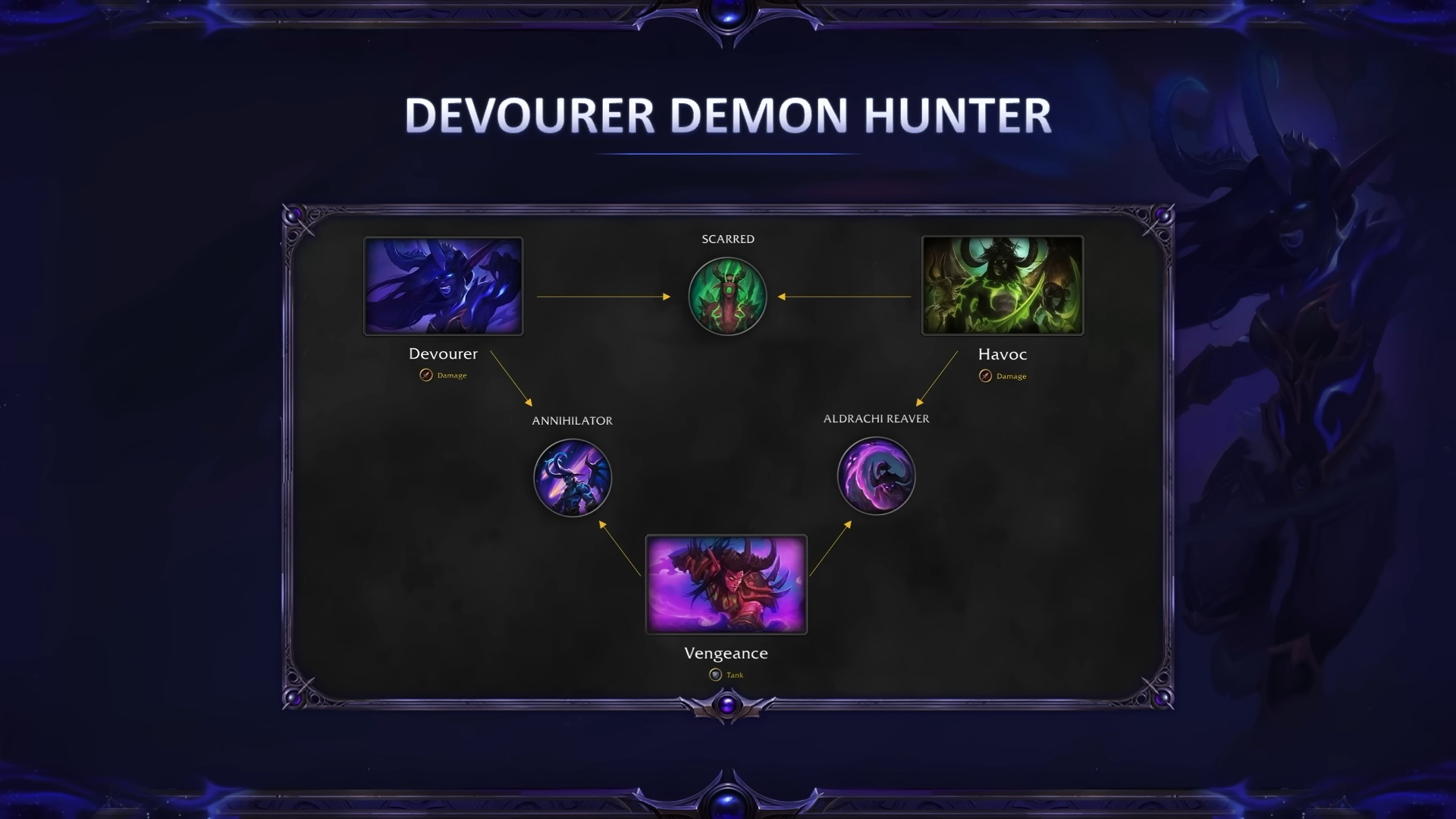
Your stat priority depends on which build you are playing: Annihilator or Void-Scarred. The differences are small, but they matter when you are chasing clean burst timing and consistent fragment generation. Priorities can also shift a bit in AoE pulls — most notably, Mastery tends to gain value for Annihilator, sometimes edging above Haste when you are focused on sustained multi-target damage.
Use these lists as a baseline, then sim your own character whenever you swap trinkets, tier, or a major talent package. Devourer Demon Hunter is a spec where breakpoints and loadouts can move the needle more than a fixed “one true” stat order, especially when you optimize for your real content (Mythic+ pulls vs Raid Bosses).
| Annihilator Stat Priority | Void-Scarred Stat Priority |
|---|---|
|
1. Intellect 2. Haste 3. Mastery 4. Critical Strike 5. Versatility |
1. Intellect 2. Mastery 3. Haste 4. Critical Strike 5. Versatility |
AoE note (Annihilator): In multi-target situations, Mastery can climb above Haste depending on your talent setup and pull pattern.
Build note (Void-Scarred): Mastery usually leads to amplify your core damage profile, with Haste close behind for smoother pacing and faster cycles.


Soul Fragments sit at the center of Devourer’s loop. They generate Fury, increase your damage output, and — most importantly — unlock access to Void Metamorphosis. Because your biggest damage spikes are tied to those Void Metamorphosis windows, the spec plays like a controlled ramp: you build resources cleanly, you enter your burst with intent, and you protect your casts so you don’t bleed value.
Outside Void Metamorphosis, the baseline loop is simple on paper: generate Fury and souls with Consume, then spend Fury on Void Ray. The reason it feels “tactical” is that execution is about timing and movement — Consume can be cast while moving, so it’s your glue spell for staying productive during mechanics, while Void Ray asks you to plant. For Void-Scarred builds, Hungering Slash also comes into play as an additional resource generator, helping you keep the engine running when you’re leaning into the melee package.
Inside Void Metamorphosis, your goal is to keep generating Fury while fitting in as many Collapsing Star casts and empowered ability casts as possible. Think of the window as a “no-wasted-GCD” test: you want resources ready, you want your next casts planned, and you want to remove unnecessary movement before you commit. If possible, Void Ray should be pressed on cooldown during the window, because letting it drift costs you both damage and momentum.
The trap is that both Void Ray and Collapsing Star have long cast times and demand that you stand still. That makes positioning a real DPS stat. Be proactive: step into safe ground before you start casting, use Shift early to “buy” a clean plant window, and avoid committing to a long cast when a mechanic is about to force movement anyway. This is especially critical for Collapsing Star: if you cancel it, it doesn’t refund the 30 souls, which turns a single mistake into a huge damage loss. Treat Collapsing Star like a commitment — only press it when you’re confident you can finish the cast.
Devourer has solid survivability without needing to sacrifice damage, mostly because your kit stacks multiple layers of “always-on” mitigation with a couple of high-leverage buttons. You have two charges of Blur for consistent coverage, passive self-healing through Soul Rending and consuming souls, and passive magic damage reduction from Demonic Wards. The practical takeaway is simple: you’re at your tankiest when you plan ahead. Don’t wait for a health panic — pre-press Blur before the hit lands, then let your passive healing stabilize you while you keep playing your rotation.
Darkness is your iconic group defensive, but it has always been weird in raids because its value is partly RNG-based. Sometimes it saves the pull, sometimes it does nothing noticeable. That said, in fights where you take frequent ticking damage (rot damage) or repeated raid-wide events, Darkness trends stronger simply because there are more chances for it to proc across the duration. In Midnight, if the encounter style leans more into constant pressure rather than single massive hits, Darkness becomes a more reliable “value over time” button. Use it where it can cover multiple damage events, not as a last-second reaction — and treat it like a bonus layer on top of proper personal defensives, not a substitute for them.
Due to current tuning, Devourer rarely wants to cast Reap or the empowered version, Cull. The main exception is when you are talented into Eradicate: in multi-target situations, you should always cast Eradicate when it’s available, because that’s where the button earns its slot.
Cast Reap or Cull with 3 stacks of Voidfall to call down Void Meteors. Also cast Reap when it gives enough souls to cast Void Metamorphosis next, since that directly accelerates your most important damage window.
Cast Reap when it gives enough souls to cast Void Metamorphosis next. In practice, this build’s flow often revolves around staying efficient during movement with your generators, then cashing in hard when you can safely plant for your long casts.
Devourer doesn’t have a set opener due to not being able to cast Void Metamorphosis instantly. However, I’ve provided examples of how an opener can look like in the beginning of an encounter:
This priority list is built around two phases: your baseline loop while you’re building toward Void Metamorphosis, and your execution inside the window where your long casts and soul spending matter most. Follow it in order, but always respect mechanics — a clean cast that finishes is worth more than a “correct” cast you have to cancel.
AoE for Annihilator follows the same core idea as single target: build efficiently to reach Void Metamorphosis, then spend that window hard without wasting casts. The difference is that multi-target pulls reward cleaner setup even more — if you enter your burst late or cancel a long cast, you lose a big chunk of the pack’s HP bar. Treat your opener GCDs like positioning tools: stabilize first, then commit to your casts.
Void-Scarred plays like a hybrid engine: you’re still building toward Void Metamorphosis, but you also weave in melee tools to accelerate resource generation and keep pressure high between burst windows. The big rule is to respect your procs and movement buffs — if you get the right setup, you can convert it into clean uptime and faster cycles. Follow the priority below, and treat every long cast as a commitment you only make from safe ground.
Void-Scarred AoE is about setting up a safe plant window, then cashing it in with your long casts during Void Metamorphosis. Outside the window, you use melee tools to keep the engine fed and to stay efficient while moving between packs. The biggest mistake in keys is forcing long casts while the pull is still chaotic — stabilize first, then commit. When you do enter Void Metamorphosis, prioritize the spells that scale best into stacked targets, and only press a long cast when you’re confident you won’t have to cancel it.
Macros are pure quality-of-life for Devourer: they don’t “play the spec for you”, but they surely remove tiny execution taxes that add up fast in real content. Devourer lives and dies by clean uptime and protected casts — the less time you waste retargeting, fumbling a cursor move, or accidentally canceling a channel, the more often you hit your real damage windows on time.
Macro to cancel Void Ray. Useful if you have to cancel the channel.
#showtooltip
/cast Void Ray
/cqs
/stopcasting
Similar to the Void Ray cancel macro, useful if you need to cancel the cast.
#showtooltip
/cast The Hunt
/cqs
/stopcasting
This macro lets you select a focus target using a mouseover. If no mouseover target exists, it will set your target as focus instead.
/focus [@mouseover,exists][@target]
#showtooltip
/cast [@target=focus] Disrupt
#showtooltip
/cast [@mouseover,exists,harm] Disrupt; Disrupt
Casts Void Nova on your mouseover target. If no mouseover target exists, it will cast it on your target instead.
#showtooltip
/cast [@mouseover,exists,harm][] Void Nova
A macro for using Shift aimed at your cursor.
#showtooltip
/cast [@cursor] Shift
These macros allow spamming Consume, Voidblade, and Reap while Void Ray is channeling, without cancelling the channel. These are your default macros for each ability:
#showtooltip
/stopmacro [channeling:Void Ray]
/cast [@mouseover,exists,harm] Reap; Reap
#showtooltip
/stopmacro [channeling:Void Ray]
/cast [@mouseover,exists,harm] Voidblade; Voidblade
#showtooltip
/stopmacro [channeling:Void Ray]
/cast [@mouseover,exists,harm] Consume; Consume