



Season 2 made every kill take longer. Max-level characters carry 25% more health, a crowd control category you have already eaten twice stays immune for twenty seconds instead of sixteen, and the rotational snares that used to pin a target down are weaker across the board. Openers set up kills now; they rarely finish them.
Longer games change the job. The specs that climb are the ones that keep a target under pressure through the second and the third attempt, and the ones that live through being the target themselves. Every damage specialization in the game sits somewhere below, melee first and ranged after. The rank ladder, the season rewards and both mounts sit in our Midnight PvP Season 2 guide.
Last updated: August 27, 2026.
A tier here answers one question: how reliably the spec turns its kit into rating. That folds performance across the three arena brackets (2v2, 3v3 and the solo-queue Solo Shuffle) together with how many people are actually willing to queue it. Neither half works alone.
Two things carry most of these placements: kill pressure that survives a healer's cooldowns, and the durability to be focused without folding. Unique utility lifts a spec on top of that — a button that removes a player from the round, or an answer the enemy team simply does not have in its own kit. Volume on a damage meter moves nothing.
Balance shifts inside a season, and these letters shift with it.
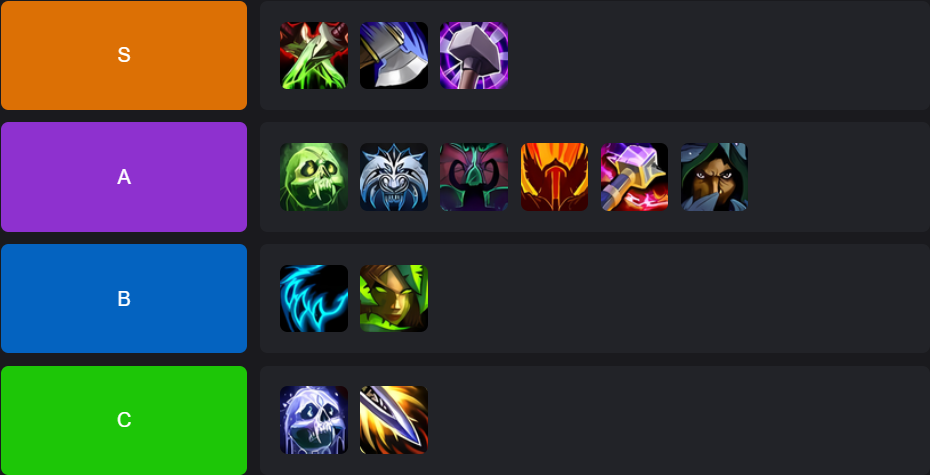
Thirteen melee specs, four tiers.
Melee answers two hard questions. Can it stay on a target that wants to leave, and can it survive the moment the enemy team turns around and picks the melee instead. The specs at the top answer both without asking a teammate for help.
Assassination Rogue is the most-played damage spec in two of the three arena brackets, and it earns the seats. Its pressure arrives as bleeds and poisons rather than as one enormous hit, which is exactly what a season of long games pays for. Deathmark into Kingsbane inside a Kidney Shot is the cleanest kill sequence in the game, and a stealth Garrote silences the target on the way in. Honestly, the counterplay has not changed. Peel the opener, then outlast the rot.
Arms Warrior holds the largest share of the 3v3 ladder of any spec on this page and the second largest in 2v2. Look, it gets there the boring way. Mortal Strike halves the healing on its target for ten seconds, Colossus Smash opens a window where everything the warrior throws lands for a third more, and Demolish is channelled inside it while the warrior takes reduced damage. Deep health pools only mean the grind takes a few more global cooldowns. Nothing Arms does is a surprise; it simply keeps arriving.
Retribution Paladin carries the highest average rating of any damage spec on the Solo Shuffle ladder. Its answer to a kill attempt is an outright immunity: Divine Shield shrugs off damage, harmful effects and knockbacks for eight seconds, which resets a fight rather than surviving one. Blessing of Sacrifice then moves a third of a teammate's incoming damage onto the paladin. The offense is not the polite half either — Hammer of Light and Final Verdict land hard enough that a healer who blinks loses the round. What it cannot do is leave. Every gap it closes, it closes on foot.
Unholy Death Knight wins by never letting a fight get quiet. Virulent Plague spreads itself to everything standing nearby, Epidemic makes every copy of it flare at once, and Army of the Dead puts eight ghouls into the middle of a stacked fight for half a minute. That damage keeps arriving while the death knight is stunned, kited or ignored, which is the whole argument for it. Two arena ladders read it S. What keeps it here is the leash — Death Grip costs ten extra seconds of cooldown in rated play, and a caster who respects it does not come back.
Windwalker Monk sits near the top of the Solo Shuffle ladder, and it gets there without ever needing a clean setup. Its damage is steady rather than explosive, which suits a format where nobody dies to a single window anyway, and Rising Sun Kick keeps landing whatever the monk is doing. Touch of Karma eats the kill attempt that would otherwise have worked and throws most of it back at the enemy, and Leg Sweep covers the setup. The ceiling is the problem. A monk who plays perfectly still needs a partner to finish the round.
Havoc Demon Hunter is built to arrive, and every piece of the kit points the same way. Eye Beam deletes anything standing together, Metamorphosis lands as a leap that dazes the players under it before the demon form even starts, and Darkness outside a raid gives everyone inside it a real chance to avoid an incoming hit entirely. The hole is the control kit. There is almost nothing in it, so the demon hunter has to create its own openings by arriving faster than the enemy can turn, and Blur is a short answer to a long focus.
Fury Warrior does one thing and does it very hard. Mountain Thane is the build the ladder plays, by a distance. Recklessness floods the warrior with Rage and crit for twelve seconds, Rampage spends it in four strikes that leave the warrior enraged, and Raging Blow fills every gap between them. Against a team that cannot peel, that is a health bar gone. What keeps it out of S is simple. Fury has to be standing there.
Enhancement Shaman reads S on the 3v3 ladder and A everywhere else, which is honestly a fair description of a spec that either deletes you or does not. Doom Winds is the window: eight seconds of Stormstrike damage landing every second on everything nearby, with Windfury firing far more often than it has any right to. Most healers cannot cover that. Feral Spirit keeps two wolves out for two full minutes and Ascendance pays for a second attempt. Outside those windows the spec is ordinary, and few lobbies have practice against a good one.
Subtlety Rogue carries the widest bracket split on this page. It reads S tier in 3v3 and 2v2 and lands near the bottom of the Solo Shuffle table, where you cannot pick your healer and a setup spec without a setup partner is a spec with a hobby. Comps decide this one. Inside a Shadow Dance the rogue keeps every stealth ability for six seconds without ever leaving the fight, and a coordinated team turns that into the best kill attempt in the game. Goremaw's Bite repeats a fifth of every finisher as bleed damage on three targets, and Eviscerate is where the combo points go. Alone in a shuffle lobby it is a very stylish B.
Feral Druid is the second spec on this page whose letter depends entirely on the bracket. It reads S in 2v2, where a partner covers the setup, and lands near the bottom in Solo Shuffle, where nobody covers anything. The kit rewards precision, and nothing else. Rip on a healer still ends games, Ravage is the finisher worth building toward, and Chomp is a hard hit the druid can only reach on an empty Energy bar. Getting to any of it is the hard part, and this season put a lot more health bar in the way.
Survival Hunter is the one melee spec that brings a hunter's toolkit to a melee fight. Harpoon roots the target and pulls the hunter to it, which closes a gap no snare was needed for, and Kill Command keeps the pet hitting while the hunter repositions. The class utility is the real argument. Scatter Shot strips every damage over time effect off a target and incapacitates it, and Roar of Sacrifice hands a focused teammate a discount and pushes the rest onto the pet. It sits low on both rating tables, and that utility is what holds it here instead of lower.
Frost Death Knight is the season's punching bag, and it sits near the bottom of both rating tables. The whole plan is one window. Pillar of Frost hands the death knight a fifth more Strength for twelve seconds, Obliterate spends it, and anyone who trinkets or blinks out of that window watches the spec do very little until it comes back. Chains of Ice is a slow rather than a root, so a target with a cooldown up simply leaves. A good Frost death knight still deletes people who stand in the wrong place at the wrong time. It just needs them to.
Outlaw Rogue sits at the bottom of the Solo Shuffle table, with only the support spec below it. The problem is kill pressure. Dispatch and Between the Eyes are honest finishers and neither of them closes a round on its own, while Killing Spree throws the rogue at whatever happens to be standing nearby rather than at the target that matters. What keeps it off the floor is the rogue toolkit underneath, because a Blind and a stealth opener win rounds on their own. No joke, a good Outlaw is frightening. Almost nobody is queuing one.
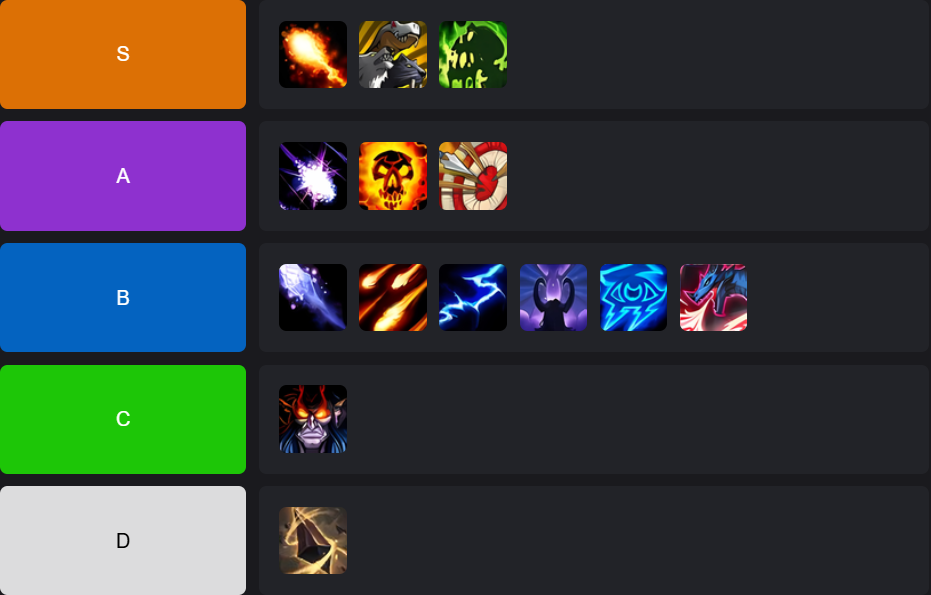
Fourteen ranged specs, five tiers.
Casting is harder than it looks. Health pools run deep enough that a clean window opens a kill rather than closing one, so the ranged specs that rank are the ones keeping damage on a target while they move, and the ones that need a quiet cast bar pay for it in every lobby.
Fire Mage tops the 3v3 rating table, and it does not need a comp built around it to get there. Combustion is the reason the spec exists: ten seconds in which every spell the mage lands is a critical strike, pressed in the middle of another cast so the window never costs a global. Pyroblast is what lands inside it. The exit is just as complete — Ice Block removes the mage from the game for ten seconds, and Mass Invisibility removes the whole team. It kills without exposing itself and leaves before the answer arrives.
Beast Mastery Hunter is S on all three arena ladders and it gets there by asking almost nothing of the player. Every point of its damage is portable: Kill Command sends the pet, Bestial Wrath makes both of them hit harder and clears the crowd control off the pet on the way, and Beast Cleave spreads it around a stacked fight. None of that needs a cast bar. Add Scatter Shot, which strips every damage over time effect off a target and puts it to sleep, and the spec has an answer for the one thing that usually kills a hunter. That is the entire pitch, and it is enough.
Affliction Warlock punishes both of the answers a team has to it. Agony starts small and grows the longer it is left alone, so ignoring the warlock gets worse by the second, and Unstable Affliction answers a dispel with a chunk of damage and a four-second silence on whoever pressed it. Malevolence turns twenty seconds of that rot into a burst window on command, and Wither stacks the damage into one target when a kill is actually on. Dispelling it hurts. Ignoring it kills you.
Balance Druid never has to choose between pressuring a target and shutting a healer down. Cyclone takes a player out of the round entirely, untargetable by either side while it runs, and Solar Beam interrupts a healer and silences everything standing under it for eight seconds. Starsurge carries the damage between them. Dispel protection is baseline now, so a team that strips the druid's rot eats Stellar Flare instead, and dispelling that one hits the dispeller and blasts them into the air. Playing around a Balance Druid means playing around four different things at once.
Shadow Priest ranks higher on the 3v3 ladder than it does in the other two brackets. Voidform hands the priest a fixed allowance of Void Volley casts rather than a cooldown, so the burst goes off when the kill is on instead of when the game says so. Shadow Word: Death closes it, at the price of a backlash if the target lives. The genuinely unpleasant button is Mindgames, which reverses the target's next chunk of damage into healing for whoever they were hitting. Where it struggles is the escape. A priest that gets sat on stays sat on.
Marksmanship Hunter trades the one-global delete for pressure that never really stops. Aimed Shot is the hit everyone plays around, Rapid Fire fills the gaps, and Explosive Shot burns the target for three seconds and splashes onto everything within eight yards of it each time it ticks. In a format where nothing dies to a single button, that shape is closer to an upgrade than a loss. Sentinel is the build, everywhere. It ranks higher in Solo Shuffle than in 3v3, because a lobby that cannot coordinate a swap gives a hunter all the room it needs.
Frost Mage reads far better on paper than it does on a ladder. Both live datasets put it mid-pack across all three arena brackets, and the reason is that its best work does not show up in a rating column. Ring of Frost holds a whole team out of a fight for ten seconds and slows whatever walks out of it, Counterspell shuts a caster out of an entire school for seven, and Ice Barrier slows anything that melees the mage through it. Control is what the spec sells. The damage behind it is ordinary, which is the whole gap. That is why it is B and not lower.
Destruction Warlock owns one enormous button and a bad delivery system for it. Chaos Bolt always critically strikes and scales further with the warlock's crit on top, and Shadowburn finishes anything under a fifth of its health and refunds itself when the target dies. The control stack is genuinely good too, since Shadowfury and a Demonic Gateway reposition a whole team. Thing is, casting is the problem. Chaos Bolt asks you to stand still in a season that made standing still expensive.
Elemental Shaman is the caster that gets better the longer a game runs. Lava Burst is a guaranteed critical strike into anything carrying Flame Shock, Earth Shock spends the Maelstrom that builds up while the shaman does nothing special, and Ascendance drops a Flame Shock and a Lava Burst onto six targets the moment it comes up. Thunderstorm knocks a stacked group off its feet and slows what it hits, and on the right map that is a kill button on its own. What it lacks is a way out. The shaman that gets picked has to be peeled by someone else.
Devourer Demon Hunter is the newest specialization in the game and nobody has finished solving it. Its filler is the interesting part: Consume and Devour are both castable while moving, so the damage never stops for a reposition, and Void Ray is where the pressure spikes. Everything real happens inside Void Metamorphosis. Survive the window, survive the round. That is the whole ceiling problem — it is threatening in bursts and forgettable between them, and the deeper health pools give opponents room to wait it out.
Arcane Mage has one genuinely unique button and a problem it cannot talk its way out of. Arcanosphere builds for four seconds, then rolls through every barrier in its path and knocks the people sheltering behind them into the air. The problem is the other two mage specs. Frost owns the control job and Fire owns the burst job, while every Arcane kill still runs through Arcane Missiles channels a lobby can see coming and interrupt, with Arcane Barrage as the payoff at the end of the ramp. Get to the end of it and the damage is real. Nobody is going to let you.
Devastation Evoker is mobile and slippery rather than untouchable, and the difference decides its tier. Unburdened Flight floors the evoker's speed instead of making it immune to snares, so a competent team can now pin one down. The damage is fine. Dragonrage is eighteen seconds of guaranteed resource procs, Deep Breath flies the evoker out of roots and loss-of-control while it burns a line through the arena, and Sleep Walk walks a player out of the round for twenty seconds. Obsidian Scales cuts a third of the damage for twelve seconds, and that is the whole defensive plan. It is short-ranged and made of paper.
Demonology Warlock is the third warlock and it plays like it. Everything the spec does runs through demons that have to be summoned, kept alive and pointed at something, and battleground and arena geometry is unkind to all three. Power Siphon eats two of those imps to make the next Demonbolt hurt, and Implosion pulls six of them onto a target and detonates them. Both are real buttons. It reads C where nobody buys the warlock the seconds a ramp needs, and a tier better in 2v2 and 3v3 where a partner can. Getting to press anything is the job.
Augmentation Evoker is barely present in the arena brackets at all, and the design is why. Ebon Might hands an ally a slice of the evoker's own primary stat, Prescience feeds crit to whichever teammate has cooldowns up, and Breath of Eons marks a group and pays back a share of everything the team lands on them. All of it is excellent inside a coordinated three. A support spec spends its whole kit making one teammate better, while a second damage dealer threatens the enemy team instead, and rated PvP pays for the second thing. The ladder has voted with its feet.