




The Omnium Folio is Patch 12.0.7's headline progression system in Midnight — a runic ledger that grants powerful combat runes through a five-week unlock cadence. Unlike past borrowed-power systems, it does not occupy a gear slot, has no respec cost, and lets you swap freely between any unlocked options. This guide covers the unlock questline, the full rune tree across all five weeks, best picks per content type, and how the system compares to Reshii Wraps.
The Omnium Folio sits structurally between a talent tree and a borrowed-power trinket. It functions as a parallel rune tree with five rows, one row unlocked per weekly reset. Each row offers two to four rune choices (one row has no choice), and you pick one rune per row. Once a row is unlocked, you can swap between its options at any time, anywhere — no respec cost, no commitment beyond the weekly unlock cadence itself.
The system does not occupy a gear slot. That is the single biggest design difference from the Onyx Annulet from Dragonflight or any of the trinket-based borrowed-power systems before it. You keep your full BiS gear loadout and gain the Folio bonuses on top.
The lore frames it as the reawakening of the Sunstrider Omnium, an ancient elven relic created by Dath'remar Sunstrider to study the schools of magic. The Omnium went dormant for decades and violently reawakened during the Midnight launch arc, erupting in a fit of arcane chaos. Magister Umbric and Grand Magister Rommath drive the unlock chain, asking the player to help reconfigure the relic before its uncontrolled reawakening spreads further chaos. Short on time? You can always buy WoW boost and let our boosters handle it.
The unlock starts in Silvermoon City, not at the Omnium itself. Grab the Magister's Missive beside the Ritual Site vendors to pick up the opening quest, The Magisters' Call.

/way #2393 47.9 51.6 — Magister's Missive, Silvermoon City.
From there the chain moves into the Magisters' Terrace library at Thalassian University, where you help Magister Umbric and Grand Magister Rommath settle arcane anomalies, work through a few puzzles, and bring the dormant Sunstrider Omnium back online. The closer, The Omnium Reawakens, switches the Folio on and awards The Sunstrider Omnium achievement. The whole chain runs roughly 15 to 20 minutes at level cap with no group requirement — a solo run with quest-text reading clears it.
Once the introductory chain is complete, the Omnium Folio opens from a dedicated minimap button, placed near where Renown details have lived in past expansions. Your first Core Rune comes from the Week 1 quest, which is available right away with no reset wait. The remaining four rows unlock one per Wednesday reset across the following weeks.
The system is per-character, not account-wide. Every alt that wants Omnium Folio access has to run the questline and earn weekly unlocks separately.
Past Week 1, the Folio grows through one Seeking Knowledge quest per week, picked up at the Sunstrider Omnium. Each quest pays a single Mote of Omnial Inquiry, the currency you spend to slot that week's new rune. Five weeks, five Motes, the full tree. There is no farm to rush it; the gating is the Wednesday reset.
| Week & Quest | Objective |
|---|---|
| Week 1: The Omnium Folio | Retrieve the Folio from Grand Magister Rommath and pick your first Core Rune. Available immediately, no reset wait. |
| Week 2: Ritualized Arcana | Collect 8 Ritualized Arcana from Elites inside Ritual Sites, roughly two full runs. |
| Week 3: Leyline Assaults | Collect 5 Dark-Ley Coalescence, one per Void Assault completed. |
| Week 4: Magical Primessence | Loot 1 Primessence (the school matches the boss) from any final dungeon or delve boss, or any Raid Finder wing boss. |
| Week 5: Off-World Magic | Defeat Imperator Pertinax on Val or Nexus-Captain Leth'ir on Naigtal for a Fragment of Alien Magic, then finish 3 World Quests on either world. |
The Sunstrider Omnium, where you turn in the weekly quests, sits at /way #2424 63.7 18.6.
Two achievements fall out of the chain: The Sunstrider Omnium for the unlock, and Omnium Folio Studies for clearing all five weeks of Seeking Knowledge quests.
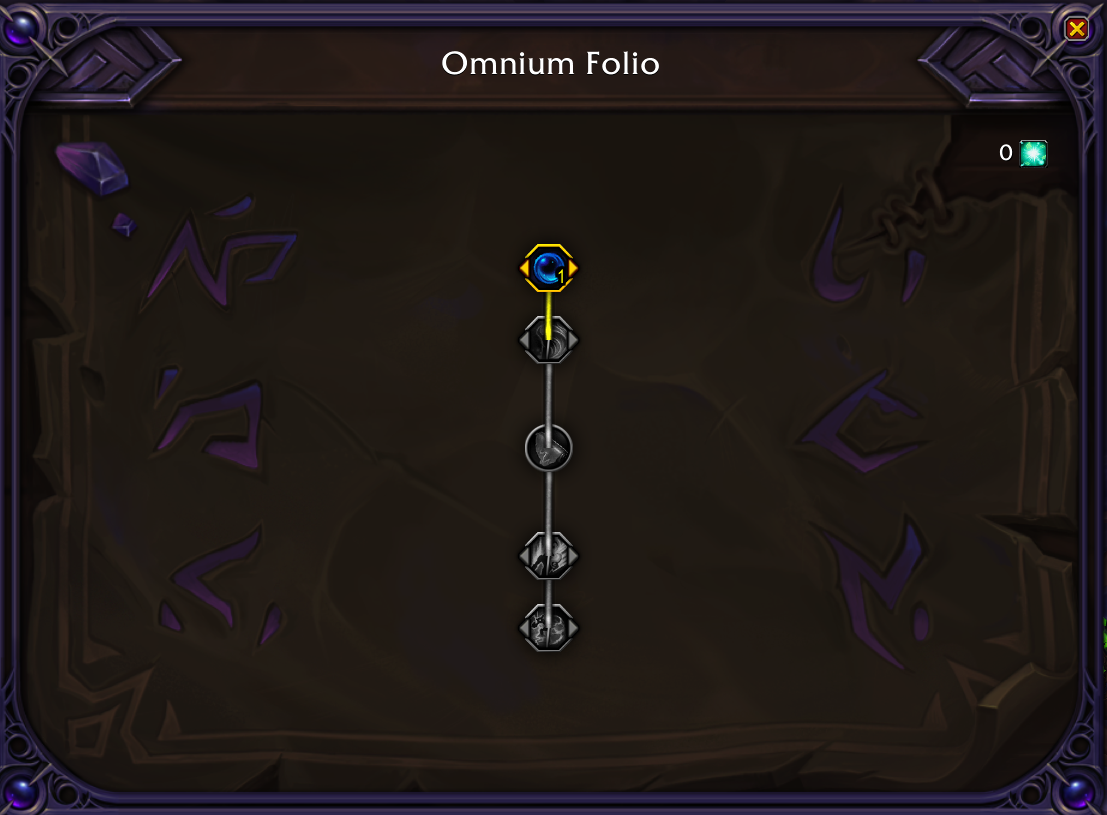
The first three weeks build the core engine of the Folio. Week 1 picks the rune that drives most of your passive output, Week 2 layers a defensive or utility option, and Week 3 adds a fixed amplifier that extends the Core Rune's effect over time.
Two options, picked the moment you finish the questline:
Rune of Void-Touched Orbs is the safer pick for nearly all specs and roles. The orb accumulation gives consistent procs even on low-APM rotations and the heal redirect scales meaningfully for healers. Unleashed Fire's pillars require positional uptime to deliver value — strong when fights let you stack on a target, weaker on movement-heavy encounters.
Three options, all defensive or movement utility:
Rune of Self-Mending is the casual / world-content default — passive healing on every dip below 75% adds up across long sessions. Rune of Void-Tainted Shell is the raid and Mythic+ pick — the absorb specifically counters one-shot mechanics that exceed 10% max HP, and the bleed-back cost is irrelevant when a healer is on you. Rune of Lynxlike Reflexes is a niche mobility pick — strong for outdoor zones, PvP kiting, or specs that already have heavy passive defensives.
Week 3 has no choice — every player gets Rune of Lingering. The rune adds an 8-second over-time effect after every Core Rune proc: enemies take Cosmic ticks across 8 seconds, allies receive healing across the same window. The base values are identical to the Core Rune's burst — Lingering effectively doubles total throughput per proc when uptime overlaps cleanly.
This is the row that rewards Core Rune uptime. If you skipped Void-Touched Orbs in Week 1 thinking Unleashed Fire's burst would scale better, Lingering tilts the math back: orbs proc more often, so Lingering uptime is more consistent.
Weeks 4 and 5 multiply the foundation built in 1–3, Week 4 layers in stacking secondary-stat rating, Week 5 adds a capstone multiplier on the Core Rune itself.
Four options, each tied to a secondary stat. Every Core Rune proc grants 52.7 rating in the chosen stat, and the buffs stack on top of each other as procs keep landing:
Match your spec's stat priority. For specs without a clear single best stat, or characters who swap specs frequently without re-picking the Folio, Versatility is the safest catch-all — it boosts both damage done and damage taken reduction, useful in every content type.
Three options, each amplifying a different prior choice:
Rune of Overload is the safest pick for almost every content type — flat doubling on the Core Rune, no setup, no uptime dependency. Rune of Residual Energy is the strongest in any rotation built around Lingering's over-time profile (long single-target fights, heavy DoT specs). Rune of Echoes has the highest ceiling but only delivers when uptime sits at 90%+ — a Mythic raid encounter where you push the same target for 6+ minutes is its ideal home; short M+ pulls or PvP burst windows under-deliver.
The Folio's free-swap design means you do not pick one build for the whole season. Swap before each session — the cost is two clicks. Recommended baselines:
The Folio's tree-style layout is structurally similar to Reshii Wraps from The War Within — pick-one-per-row, free swap once unlocked, parallel to your normal talent tree. The differences matter:
For players who used Reshii Wraps in TWW, the Folio interface will feel familiar but the choice weight is heavier. Picks here actually change build feel in a way Reshii Wraps' picks rarely did — Rune of Echoes vs Rune of Overload vs Rune of Residual Energy is a real DPS profile decision, not a cosmetic flavor swap.