




Gearing for arena in The Burning Crusade runs on two currencies and one stat that decides whether you live long enough to spend the rest. Honor Points buy your entry epics and every off-slot piece; Arena Points buy the season set that sets your power ceiling. Resilience, the stat that lowers how often and how hard you get crit, is what separates a geared arena player from a raider who folds in the opening stun.
The path is the same in every season, only the names on the gear change. The destination is a full current-season Gladiator set backed by resilient honor off-pieces, the gear band where matches stop being decided by who got opened on first. Gear in the wrong order and you burn weeks of Arena Points on slots you should have bought with Honor. This is the order that saves the most time.
Two reward currencies feed your character, and they do not overlap. Honor Points, earned from kills and battleground objectives, cover your weapons, your off-slot pieces, and, once a new season opens, the previous season's arena set. Arena Points (AP), handed out weekly based on your arena rating, buy only the current season's five-piece set and its season weapons. Honor is a grind you control. AP is gated behind playing rated matches.
Resilience is the whole reason PvP gear exists. Each point reduces your chance to be critically hit, the damage those crits deal, and the damage of critical damage-over-time ticks. A raider in fresh Tier gear walks into a 2v2 and gets globaled by a single Rogue opener, because nothing on that gear stops the crit chain. Honor and arena pieces carry resilience on almost every slot. That stat, not raw item level, is your admission ticket.
Stamina matters just as much. Bigger health pool plus resilience is what buys you the seconds your healer needs. Glass-cannon PvE gear does the opposite: it dies fast. The season set carries a different name each tier, but the role never changes. Whatever season you're reading this in, "the current set" and "last season's set" map to this ladder:
| Arena season | Set name | Raid tier |
|---|---|---|
| Season 1 | Gladiator's | T4 (Karazhan, Gruul, Magtheridon) |
| Season 2 | Merciless Gladiator's | T5 (Serpentshrine, Tempest Keep) |
| Season 3 | Vengeful Gladiator's | T6 (Black Temple, Hyjal) |
| Season 4 | Brutal Gladiator's | Sunwell Plateau |
The arena hub is Area 52 in Netherstorm, around 33, 64. Every current-season set piece, the older sets that have dropped their rating gates, and the season weapons sit with the vendors here.
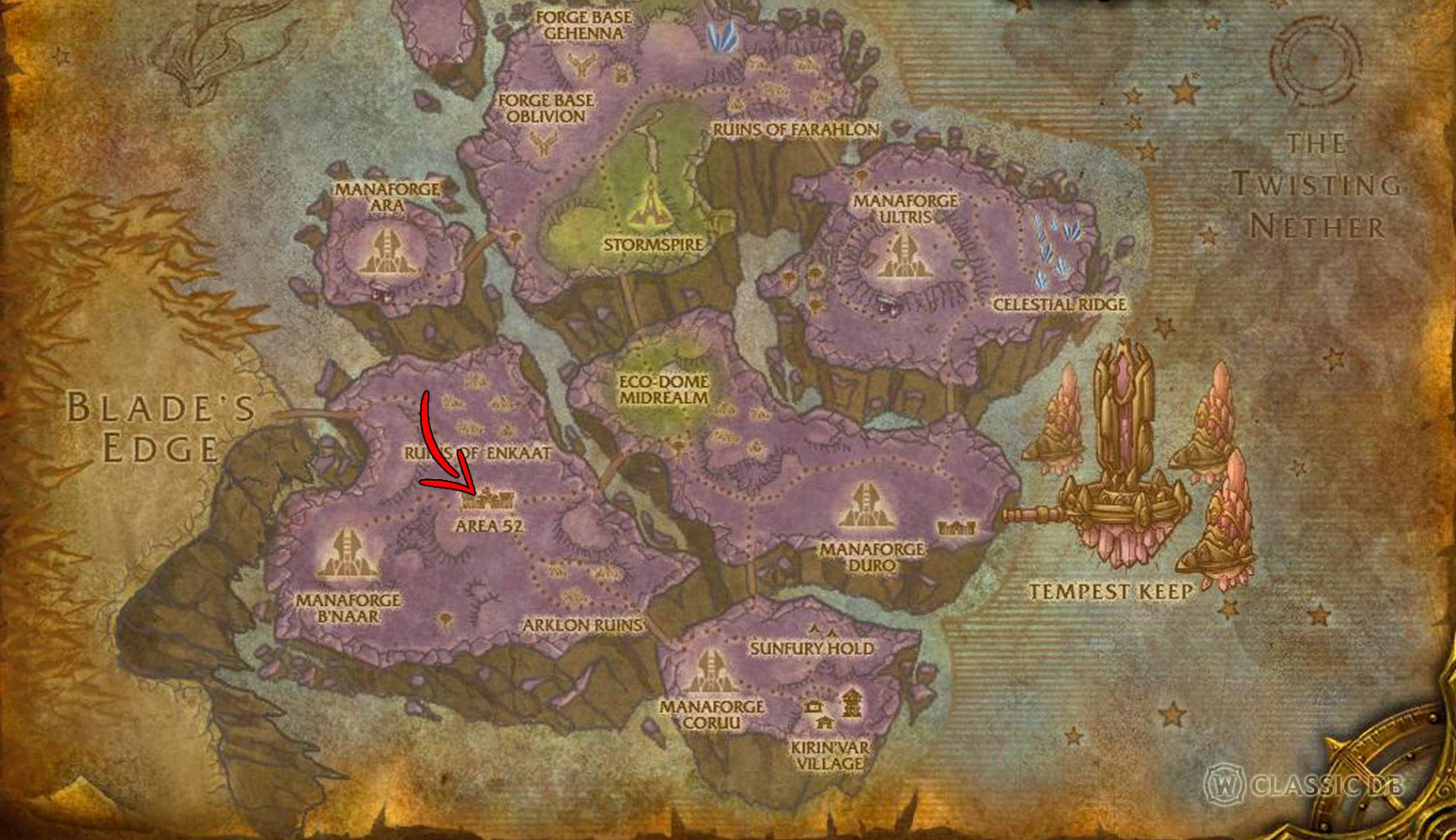
The arena outside the Ring of Trials in Nagrand holds a mirror set of vendors if you want to shop closer to a match.
Honor gear splits between that same hub and your faction capital. Off-slot pieces and the Medallion trinket are bought with Honor Points; last season's arena armor, once it goes honor-priced, also lives with the Area 52 vendors. The Anniversary realms scrapped the old battleground-mark requirements on this gear, so Honor Points alone cover it now. You still farm that Honor in the four battlegrounds: Alterac Valley, Arathi Basin, Warsong Gulch, and Eye of the Storm.
The fast path is not "save up and buy the best set." It is buying survivability first with cheap currencies, then converting Arena Points into the slots nothing else can fill. The order below runs from your leveling pieces to a full season set, and it holds every season.
You can gear for PvP before you hit 70. The Bone Wastes in Terokkar Forest hold five Spirit Towers; whichever faction controls all five earns the Blessing of Auchindoun and can loot Spirit Shard tokens from Auchindoun dungeon bosses. Mana-Tombs and Auchenai Crypts drop one shard per boss, Sethekk Halls and Shadow Labyrinth two. If you're already running those dungeons to level, you're sitting on a currency most players ignore.
Spend the shards at Spirit Sage Zran in Allerian Stronghold or Spirit Sage Gartok in Stonebreaker Hold. The Band of the Exorcist is the prize: a melee resilience ring usable at level 67 that holds a slot well into your arena career, for 50 shards. There's also a meta-socket helm usable at 66 and cheap meta gems at 8 shards each. None of it is mandatory. All of it is a free head start.
In Season 1, your foundation is the blue PvP set: head, shoulders, chest, gloves, and legs. The slow way is grinding Honor in battlegrounds. The fast way is gold, since each piece sells for a handful of gold from the Outland faction quartermasters (Honor Hold or Thrallmar, Cenarion Expedition, Lower City, Keepers of Time, and the Sha'tar) once you reach the required reputation, Revered at launch and eased to Honored later. If you leveled through Outland at all, you're most of the way there already.
From Season 2 on, you can mostly skip this step. With the previous season's epic set selling for Honor at no rating (Step 4), a fresh 70 is better off banking Honor straight into those epics. Grab a cheap gold blue piece only for a slot you can't cover yet.
Before you queue a single match, buy the Medallion of the Horde or Medallion of the Alliance from your capital. It clears every movement-impairing and loss-of-control effect on a 2-minute cooldown: stuns, fears, roots, the lot. There are two crowd-control break trinkets and only one is correct. The Medallion carries resilience and the 2-minute cooldown; the older Insignia has no resilience and sits on five minutes. Take the Medallion. Against a Rogue or Mage opener, that escape is the match.
Then sweep the off-slots Honor covers with no rating requirement: cloak, both rings, neck, bracers, boots, and belt. Every one carries resilience and stamina. Buy them in stat-priority order: cloak first since it's cheapest, then rings and neck, then bracers, boots, and belt last. Seven slots of resilience for pure Honor, no arena win needed.
This is the step most fresh players skip, and it's the biggest single jump you'll make. When a new arena season opens, the previous season's armor loses its rating requirement and drops in price, sold for Honor instead of Arena Points. Buy the chest, legs, gloves, helm, and shoulders. In Season 1 there's no prior set to fall back on, so the blue starter from Step 2 carries you until the points roll in.
Replacing your blue set with these epics roughly doubles your effective health once the stamina and resilience land. Honor is faster than Arena Points, the gear is rating-free, and a full last-season set is enough to compete while you grind the real one.
Now the season set, bought with Arena Points. Each week's points go toward swapping a last-season piece for its current-season upgrade. Prioritize the slots with the biggest stat budget: chest, legs, and helm carry the most stamina and resilience, so they pay back fastest. Gloves are the cheapest piece and a fine early grab. Shoulders come last because they're gated.
Set bonuses change the early order. Every Gladiator set's 2-piece bonus is +35 resilience, and you can run two different 2-piece bonuses at once, this season's two pieces plus last season's two, for +70 resilience total. That stack often beats rushing a single 4-piece. The 4-piece is the class-defining bonus you build toward: a shorter Intercept cooldown for Warriors, a faster Fear cast for Warlocks, and so on down the roster. Chase your four current pieces once survivability is handled.
Two slots sit behind a personal rating wall. On the Anniversary realms the season weapon needs 1700 rating, lowered from the original 1850, so it's in reach for most teams that grind consistently. Shoulders need 2000. Everything else in the season set has no rating gate at all; it's a points-and-patience problem, not a skill wall.
Until 1700 clicks over, bridge the gap with last season's weapon. Once a new season opens, the prior Gladiator weapon goes rating-free for Honor, and it carries resilience that no PvE weapon offers, so it's the cleanest stopgap. In Season 1, before any of that exists, lean on a reputation weapon from Exalted with an Outland faction or a Badge of Justice off-hand from heroics instead. Either way, the arena weapon is usually your single largest upgrade the day you can buy it.
Most of the gearing wall people imagine doesn't exist on the Anniversary realms. Everyone starts at 1500 rating, and you can reset back to 1500 once a week if you've slipped below it, so a rough start never sticks. The requirements came off almost every slot, and the gates that remain are the same every season.
| Reward | Rating needed | Currency |
|---|---|---|
| Chest, Legs, Helm, Gloves | None | Arena Points |
| Shoulders | 2000 | Arena Points |
| Season weapons | 1700 | Arena Points |
| All off-slot honor gear | None | Honor |
| Gladiator title + Nether Drake mount | Top 0.5% of realm | End-of-season cutoff |
So the real progression is straightforward: gear the no-rating slots with Honor and points, push to 1700 for your weapon, and only the truly competitive chase 2000 shoulders and the realm's top cut. Each season the best 0.5% on the ladder earn the Gladiator title and that season's Nether Drake mount when it closes. That's a different project from gearing; it's a rating push.
Arena Points pay out once a week at the reset, and the amount keys off your rating in your highest-rated qualifying bracket. To qualify you play at least 10 games in that bracket for the week, with a chunk of them on your own character so you can't just be carried on a roster. Higher rating means more points, scaling up until it flattens out in the high brackets.
The Anniversary realms changed how that rating is held. Team charters are gone. Your rating is personal now, tracked on your own character per bracket rather than locked to a registered team. You still queue as a formed group of two, three, or five; bring teammates, just without the old charter step. Build the roster you can field, and your weekly points key off your own bracket rating.
Bracket choice changes the math. For the same rating, 5v5 pays the most points, 3v3 less, 2v2 the least. That's why 5v5 is the quiet favorite for pure point farming even though 2v2 and 3v3 draw the crowds and the titles. If your only goal this week is a faster set, a stable 5v5 team at a modest rating out-earns the same rating in 2v2.
The catch is obvious. 5v5 needs five coordinated players, and most people don't have them. Pick the bracket you can actually field.
Gear with empty sockets and bare slots is half-geared, and in a bracket that gap is the difference between surviving an opener and dying to it.
Gems. Stamina is the default. A flat stamina gem in most sockets buys more arena survivability than a few points of your main stat, so only match a socket color when its bonus beats that stamina outright. Resilience gems layer on extra mitigation if you want it, but the stamina trade usually wins. Casters and healers slot spell power or intellect where the socket bonus justifies it; melee favor stamina and their primary attack stat. Your meta gem counts too. The Spirit Shard metas, Swift Windfire for attack power and Swift Starfire for spell damage, are a cheap early fill you upgrade to a stronger class-appropriate meta once gold allows.
Enchants. Enchant every slot you can afford. Weapons come first: Mongoose on most melee, spell power or healing on casters, major stamina on shields and off-hands. Chest takes health or raw stats, cloak takes greater agility or spell penetration, boots take movement and stamina, and legs take an armor kit or a spellthread. The resilience head glyph people ask about, Glyph of the Gladiator, only shows up in the Sunwell phase. Until then, run the best class-appropriate head enchant from your Aldor or Scryer reputation in Shattrath. Shoulders take an inscription from the same Aldor or Scryer quartermaster, the stronger version once you hit Exalted.
Professions. A few trades pull ahead for PvP. Blacksmithing adds a socket to gloves and bracers, straight stamina nobody else gets. Jewelcrafting unlocks unique gems a cut above the common quality. Engineering is the standout: on-use gadgets and a glove tinker that swing matches outright. Tailoring adds a spellthread to your legs, Leatherworking adds drums and a heavier leg armor kit, and Enchanting puts stats on your rings. None of it is mandatory. At the margins, it's free rating.