




Trading is the fastest way to gear a character in PoE 2, and 0.5 Return of the Ancients made the whole thing far less painful than the website-only grind veterans remember. The Runes of Aldur league runs three trade channels side by side: a bulk Currency Exchange, asynchronous gear selling out of your hideout, and old-fashioned player-to-player whispers. Each one covers a different kind of deal. Knowing which to reach for is half the skill.
The payoff is control over your own gear curve. A handful of Exalted Orbs turns into a capped resistance ring in under a minute, and the rare you'd never land in a hundred crafting slams is already sitting on the market for less than the materials would cost you. This guide walks all three systems for the current league: how to buy, how to sell while you're logged off, and how to move currency in bulk without getting fleeced.
Three separate systems handle every trade in the game, and they barely overlap. Pick the wrong one and you'll waste gold or sit in a party doing manual swaps that the game could have automated. Here's the split.
| Trade Method | Best For | Both Players Online? |
|---|---|---|
| Currency Exchange | Bulk orbs, runes, Soul Cores, Essences, fragments | No (async) |
| Merchant's Tab (Hideout Shop) | Selling gear and uniques while you're offline | No (buyer teleports in) |
| Direct Whisper Trade | One-off gear buys and anything not listed cheap | Yes |
Each one unlocks at a different point. The Currency Exchange is open early: talk to Finn at the Clearfell Encampment in Act 1 and pick "Currency Exchange," with a matching currency NPC in every town after. Direct whispers work as soon as you can reach the trade site. The async shop lands last: it needs your own hideout, then you recruit Ange in King's March during Act 4 to sell gear while you're logged off.
One rule sits under everything: gold cannot be traded between players. You earn it from kills and vendor sales, and it pays for exchange listings, hideout-shop purchases and passive respecs, but it never changes hands in a deal. That's deliberate. It stops gold from quietly becoming the one currency that prices everything, which is the job Exalted Orbs and Divine Orbs do instead.
The official trade site is the GGG-maintained indexer for every listed item in the league. Filter by base type, item level, sockets, and the exact affixes you want, then sort by price. There's also an in-game version of the same browser; open it with the forward-slash key or the hamburger menu, no alt-tab required.
Buying a listed gear piece runs on the whisper flow:
Plenty of gear now skips that dance entirely. Listings sold through a hideout shop show a Secure Item button: click it, get teleported straight to the seller's hideout store, and buy the piece even if they're offline. When you see that option, take it. It's faster and it can't be sniped out from under you mid-whisper.
Since gold stays out of trades, gear is paid for in currency. Exalted Orbs cover the small buys; Divine Orbs handle the expensive ones; Chaos Orbs float in between. Keep a stack of each on you so you're not scrambling to make change in someone's hideout.
PoE 2 Gearing GuideSelling gear used to mean staying logged in to answer whispers. Not anymore. The Merchant's Tab lets you price an item, list it, and walk away. Buyers find it through Ange's shop and the trade site, then teleport in to grab it whether you're online or not. You collect the currency later from a remove-only tab in her interface.
There's a catch on access. A Merchant's Tab is either a direct MTX purchase or a converted Premium Stash Tab, and only Premium Tabs bought before 29 August 2025 qualify for conversion. Quad Stash Tabs can't be converted at all. The async shop is also disabled in SSF (Solo Self-Found), which trades by design.
Pricing is the part people fumble. Search the trade site for your exact item first, read the going rate off the cheapest few real listings, then undercut slightly if you want it gone fast. Sellers pay no listing fee, so there's no downside to pricing for a quick flip — a sold item beats a "valuable" one rotting in your tab. The buyer covers a small gold tax on top of your asking price, not you.
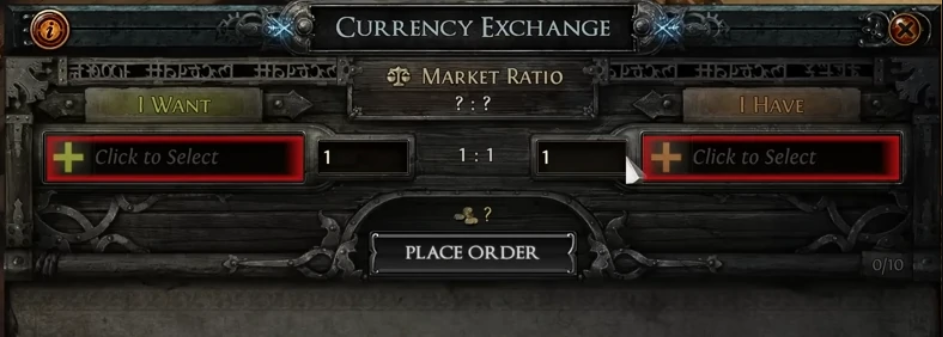
This is the system that saves you the most time. The Currency Exchange is a bulk, order-book market for anything stackable — and it never asks you to whisper a soul. You place an order, log off, and come back to filled trades. No parties, no haggling, no scams.
The flow is two boxes. Pick what you want in one, what you have in the other, and the game shows a live market ratio pulled from real orders. Accept that rate for an instant fill against existing orders, or set your own and wait for someone to match it. Placing the order costs a gold fee that scales with the rarity and size of the trade: small for a stack of Transmutes, heavier for Divines in volume.
It handles far more than the headline orbs. Runes, Soul Cores, Essences, Omens, Catalysts, Distilled Emotions and boss fragments all trade here in bulk. If you farm a league mechanic and end up with two stash tabs of the same drop, this is where you convert the pile into Divine Orbs without listing a hundred separate whispers.
One habit pays off: don't dump a huge stack at the instant-fill rate. Set a limit order a little better than market and let it fill while you map. The difference between accepting the spread and setting your own price adds up fast over a league.
The community runs on a few unwritten rules. Break them and you'll get ignored, blocked, or worse, flagged as a time-waster. They're simple:
The async systems killed most of the classic scams — a Secure Item purchase locks the price, so nobody swaps in a worse item at the last second. The trap that survived is price-fixing. A handful of listings will sit far below market with no intention of selling; they exist to scare you into pricing your own drops too low, or to bait a whisper that gets ignored. Read past the top listing, always. The honest price is the cluster of five or six similar entries, not the single suspicious outlier at the top.
On the GGG-run trade site, through the in-game market browser (forward-slash key), or via the Currency Exchange for bulk stackables. Gear buys still finish with a whisper or a one-click Secure Item teleport into the seller's hideout.
You don't have to grind for it. The Currency Exchange is open from Act 1: talk to Finn at the Clearfell Encampment and choose "Currency Exchange," with a matching currency NPC in every town after. The async hideout shop is a separate unlock that needs Ange in Act 4.
For the async hideout shop, yes. A Merchant's Tab is an MTX purchase or a converted Premium Stash Tab bought before 29 August 2025; Quad Tabs don't qualify. Without one you can still sell through direct whisper trades, just not while offline.
No. Solo Self-Found blocks all trade by design: no Currency Exchange, no shop, no player-to-player deals. Everything you use is something you found yourself. Switching out of SSF is a one-way trip to Standard.
Prefer Secure Item purchases, which lock the price and item. For manual trades, confirm both sides of the window before accepting, and price-check against several listings on poe.ninja so a price-fixed outlier doesn't fool you into selling cheap.